Stress vs Strain: Key Differences, Relationship and Engineering Applications
In mechanical engineering and materials science, stress and strain are two of the most fundamental concepts used to understand how materials behave under load. Whether you’re designing a machined component, selecting materials for injection moulding or validating a part for real-world use, understanding the differences between stress and strain is essential.
Engineers rely on stress–strain analysis to:
- Predict material deformation
- Prevent mechanical failure
- Optimize part geometry and material selection
- Ensure safety, durability and performance
In manufacturing contexts, especially CNC machining, additive manufacturing and precision engineering, misunderstanding the stress-strain relationship can lead to fractured parts, excessive deformation or costly redesigns.
This guide explains the differences between strain and stress clearly and practically by covering definitions, formulas, curves, real-world examples and how these concepts are applied in engineering and manufacturing.
Definitions and Core Concepts
What is Stress?
Stress is the internal force experienced by a material per unit area when an external load is applied.
Definition
Stress (σ) = Force / Area

Units
- Pascals (Pa)
- Megapascals (MPa) – most common in engineering
Gigapascals (GPa)
Example
If a steel rod is pulled with a force of 10,000 N and has a cross-sectional area of 100 mm², the stress inside the rod determines whether it stretches elastically or fails.
Stress tells engineers how much internal resistance a material generates when loaded.
What is Strain?
Strain measures how much a material deforms when stress is applied.
Definition
Strain (ε) = Change in length / Original length

Units
- Strain is dimensionless (no units)
- Often expressed as mm/mm or as a percentage
Example
If a 100 mm component elongates by 0.5 mm under load, the strain is 0.005 or 0.5%.
Strain describes how much a material changes shape or size, not the force causing it.
Stress vs Strain: The Key Difference
Stress and strain are often discussed together, but they serve different roles in engineering analysis and manufacturing design. The table below summarizes their key differences and how each is used in practice.
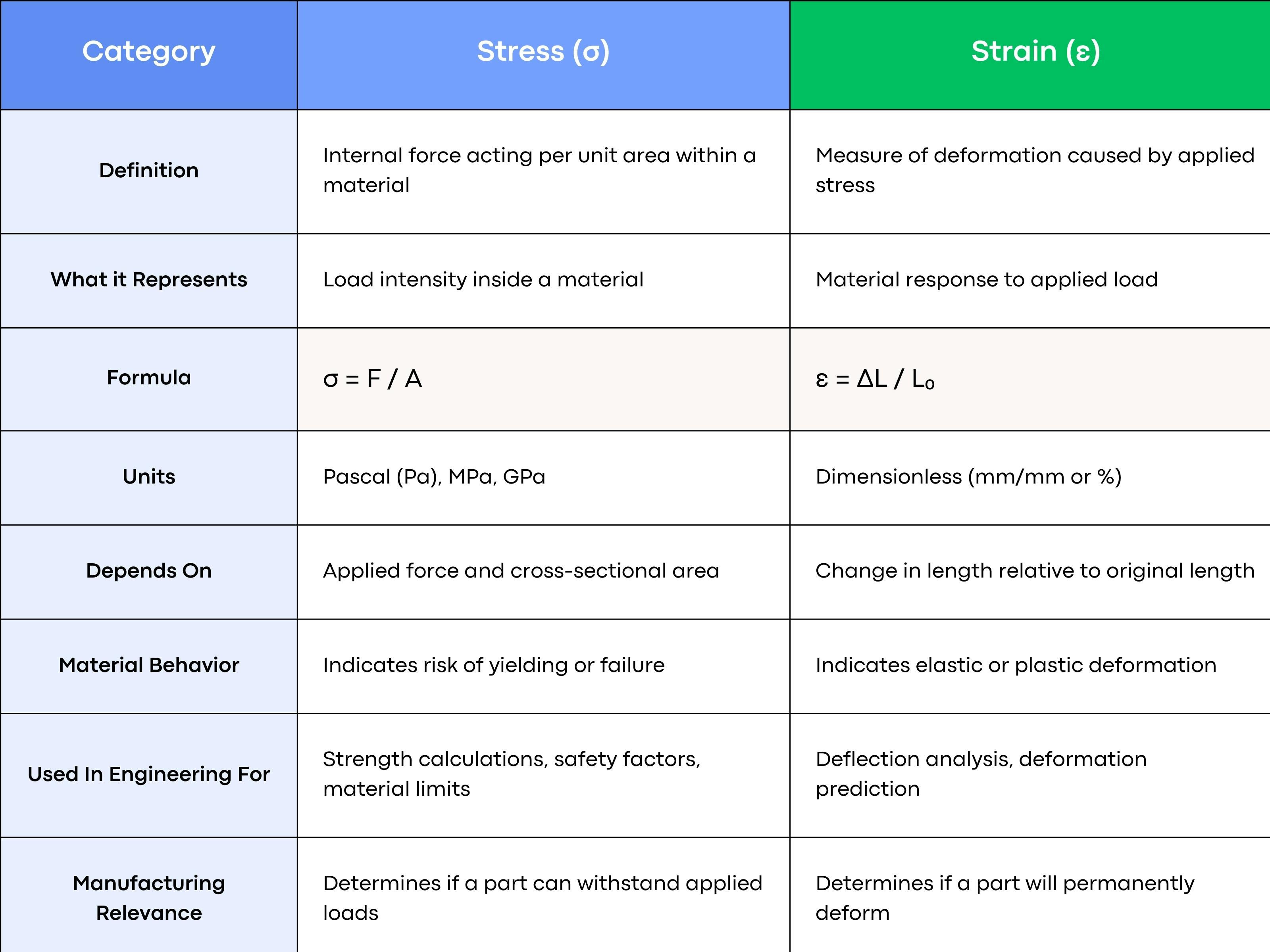
In simple terms:
- Stress is what you apply
- Strain is how the material reacts
Understanding stress vs strain is about understanding cause and effect in material behavior.
Stress vs Strain Relationship
The stress-strain relationship explains how materials respond as the load increases. This relationship is fundamental to mechanical design and material selection.
Elastic Region
In the elastic region, stress and strain are directly proportional.
- Material returns to its original shape when the load is removed
- No permanent deformation
- Behavior is predictable and linear
This region is governed by Hooke’s Law.
Hooke’s Law Explained
Hooke’s Law states:

Where:
- σ = stress
- ε = strain
- E = Young’s Modulus (Elastic Modulus)
In spring systems, Hooke’s law is often written as F = kΔL, but for materials we use σ = Eε.
Young’s Modulus (Elastic Modulus)
Young’s Modulus measures material stiffness.
- High Young’s modulus → stiff material (e.g. steel)
- Low Young’s modulus → flexible material (e.g. rubber)
Units
- Pascals (Pa)
- Typically expressed in GPa
Why it matters
In manufacturing, Young’s modulus helps engineers predict:
- Deflection in beams
- Vibration behavior
- Dimensional stability of machined parts
Material stiffness and elastic limits should always be considered alongside available CNC machining materials when selecting alloys or plastics for load-bearing components.
Plastic Region
Once stress exceeds the elastic limit:
- Material enters the plastic region
- Deformation becomes permanent
- Removing the load does not restore the original shape
Most metal forming processes (bending, stamping, forging) rely on controlled plastic deformation.
These elastic and plastic behaviors are especially important when designing parts for precision CNC machining, where deformation or yielding can directly affect part accuracy.
Mechanical Stress and Strain Types
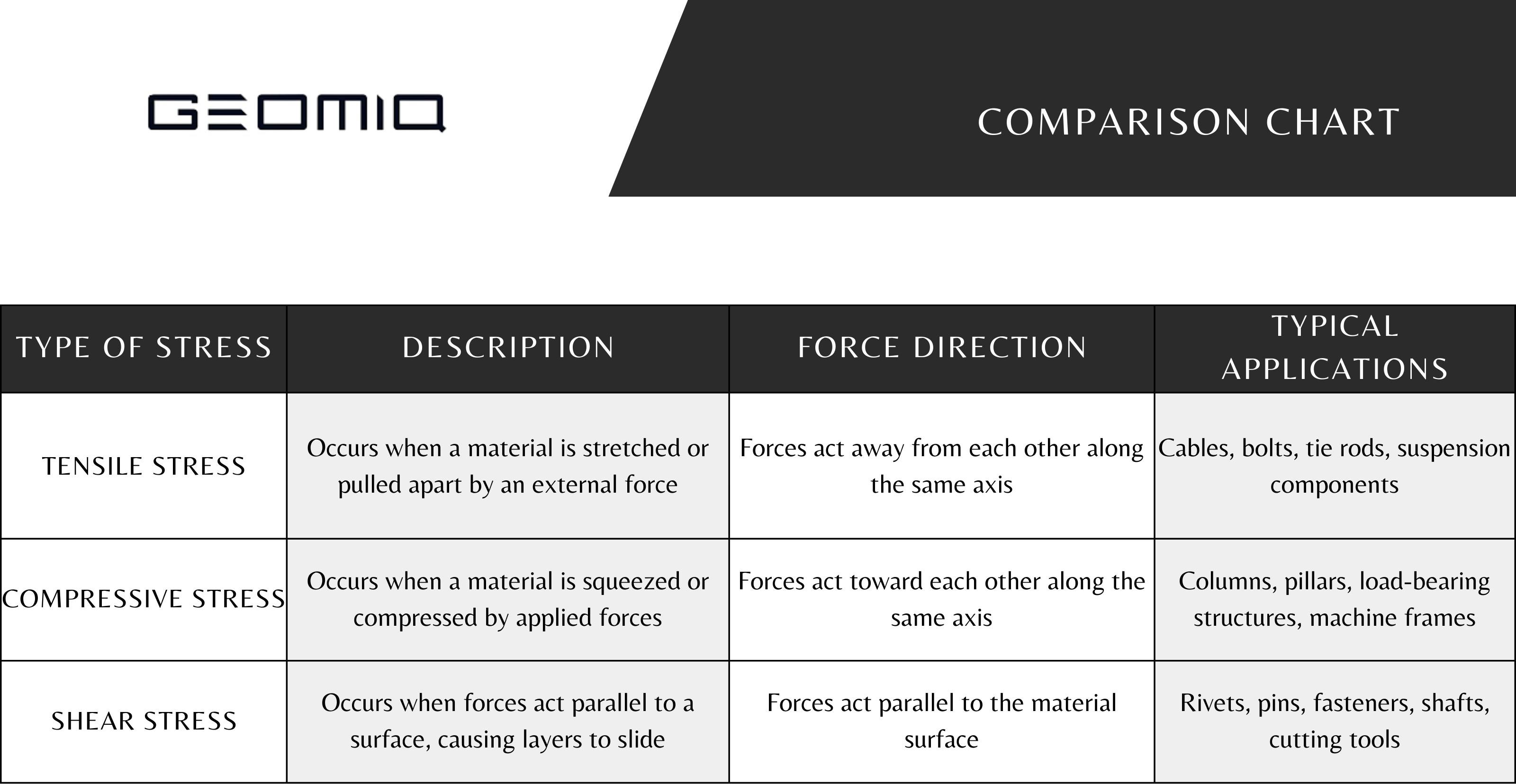
Materials experience different forms of stress when forces are applied in tension, compression, or shear. Identifying these stress types is a fundamental step in structural design and manufacturing analysis.
Types of Stress
- Tensile Stress
- Occurs when material is pulled apart
- Common in cables, bolts, and tie rods
- Compressive Stress
- Occurs when material is squeezed
- Found in columns, load-bearing structures
- Shear Stress
- Acts parallel to the surface
- Common in rivets, pins, and fasteners
Understanding these stress types is critical in CNC machining, structural design and component validation. Incorrectly accounting for tensile, compressive, or shear stress is a common issue highlighted in many CNC design mistakes that lead to part failure or rework.
Types of Strain
Strain describes how a material deforms in response to applied stress. Strain control becomes even more critical when working within tight limits defined in CNC machining tolerances, especially for high-precision or functional components.
Different strain definitions are used depending on the level of deformation and the type of engineering analysis being performed.
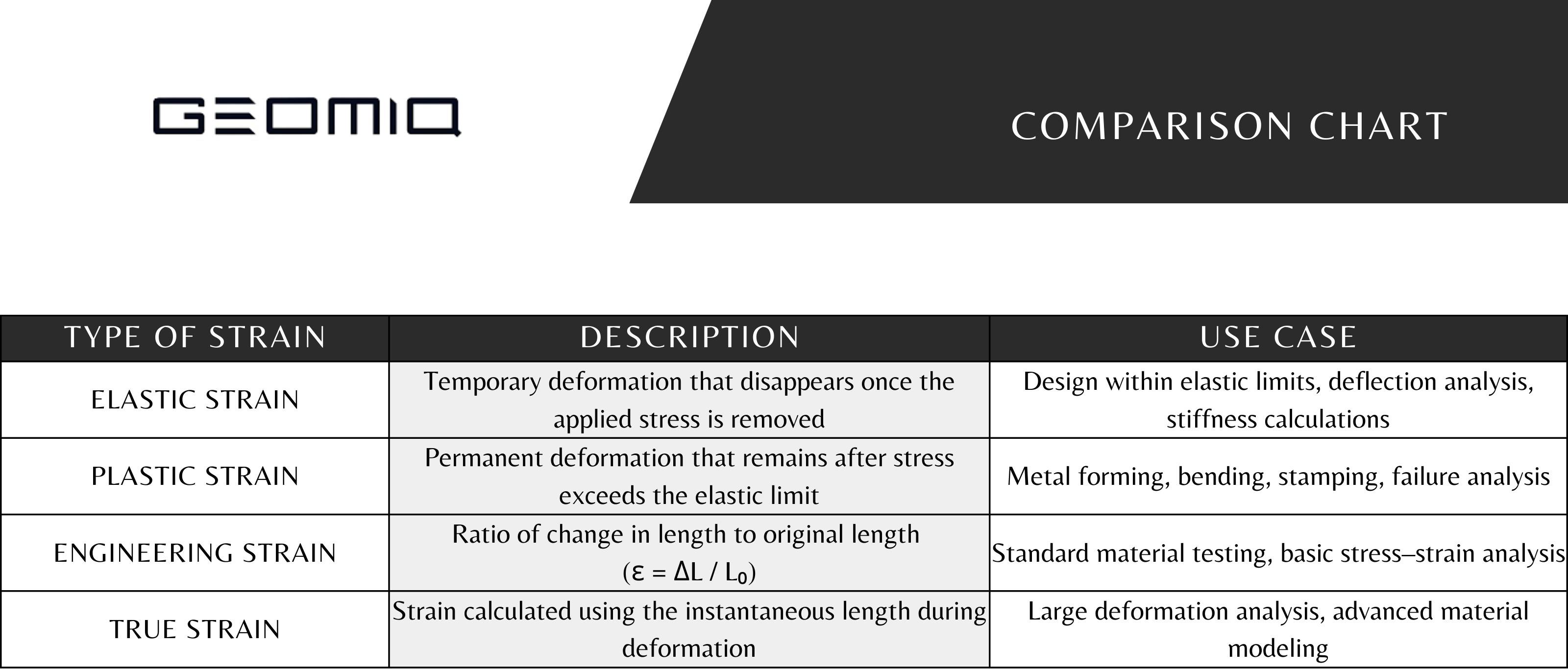
- Elastic Strain - Temporary deformation
- Plastic Strain - Permanent deformation
- Engineering Strain - Based on original dimensions
- True Strain - Accounts for continuous dimensional change
In precision manufacturing, engineering stress–strain is commonly used for standard analysis, while true stress–strain is preferred for large deformation and advanced material modeling.
Stress–Strain Curve Explained
The stress–strain curve visually represents how a material behaves under increasing load.
Key Regions and Points
- Linear Elastic Region
- Straight line
- Obeys Hooke’s Law
- Yield Point
- Material begins plastic deformation
- Permanent strain occurs
- Ultimate Tensile Strength (UTS)
- Maximum stress material can withstand
- Fracture Point
- Material failure
Ductile vs Brittle Materials
- Ductile materials (e.g., aluminum, steel) show large plastic regions
- Brittle materials (e.g., ceramics) fail with little plastic deformation
This distinction is critical when selecting materials for manufacturing and end-use performance. The difference between ductile and brittle behavior is particularly relevant when comparing CNC machining and sheet metal fabrication for structural or formed parts.
Real-World Engineering Applications
Beams Under Load
Structural beams experience bending stress:
- Top surface: compressive stress
- Bottom surface: tensile stress
Accurate stress–strain analysis prevents excessive deflection or collapse.
Cables and Wires in Tension
Cables in cranes, elevators, or suspension systems must:
- Remain within elastic limits
- Avoid plastic deformation or fatigue failure
Stress calculations ensure long-term safety.
Machined Parts and Manufacturing
In CNC machining and production:
- Residual stresses can affect dimensional accuracy
- Thin-wall parts may deform under clamping forces
- Incorrect material selection can lead to early failure
Understanding the differences between stress and strain helps manufacturers design parts that are strong, reliable and cost-effective.
Conclusion: Stress vs Strain in Modern Engineering
Comparing stress and strain is essential for anyone involved in engineering design, materials science or manufacturing. These concepts explain how materials respond to forces, where failure occurs and how to design components that perform reliably in real-world conditions.
From stress–strain curves to Young’s modulus and plastic deformation, mastering these fundamentals enables:
- Better material selection
- Safer designs
- More efficient manufacturing processes
Next Steps with Geomiq
If you’re designing parts that must withstand real-world mechanical loads, Geomiq can support you with:
- Material selection guidance
- Precision manufacturing services
- Engineering-ready production at scale
Explore Geomiq’s manufacturing solutions or request a quote to bring your designs to life.
About the author
Sam Al-Mukhtar
Mechanical Engineer, Founder and CEO of Geomiq
Mechanical Engineer, Founder and CEO of Geomiq, an online manufacturing platform for CNC Machining, 3D Printing, Injection Moulding and Sheet Metal fabrication. Our mission is to automate custom manufacturing, to deliver industry-leading service levels that enable engineers to innovate faster.