How to Choose a CNC Machining Partner in Oxford
Oxford brings together university research, aerospace development, medical technology and advanced engineering within a concentrated technical ecosystem. This creates strong demand for precision-machined components, particularly for projects involving complex geometry, short production runs, controlled tolerances and documented quality requirements.
For engineering teams sourcing CNC machining in Oxford, understanding these sector-specific requirements is more useful than a general explanation of how milling and turning work. This guide examines the industries driving local demand, the sourcing decisions Oxford engineering teams face and the technical criteria that distinguish a capable CNC machining partner from a general-purpose machine shop.
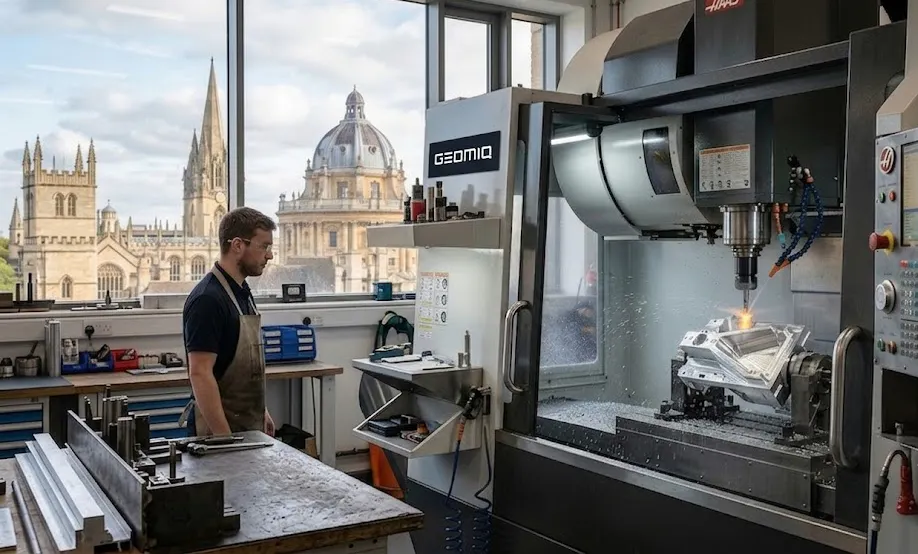
Oxford’s Engineering Landscape: Research, Aerospace and Life Sciences
Oxford’s manufacturing environment is closely connected to the University of Oxford, Oxford Science Park, Begbroke Science Park and the wider Oxfordshire engineering network. These organisations support research and commercial development in materials science, medical technology, diagnostics, aerospace, energy and scientific instrumentation.
Nearby research centres such as Harwell Campus, Culham Science Centre and the Rosalind Franklin Institute extend this technical network beyond the city. As a result, an Oxford manufacturing company may need to produce research fixtures, satellite housings, diagnostic components and precision test equipment rather than conventional high-volume industrial parts.
This project mix creates demand for suppliers that can support prototype and low-volume production while maintaining reliable inspection, material traceability and repeatable manufacturing processes.
Why Oxford’s Manufacturing Base Demands Precision CNC Capability
Companies choose CNC machining in Oxford because many local engineering programmes require more than basic subcontract manufacturing. Aerospace, medical and scientific applications frequently specify tight positional tolerances, controlled surface finishes and full material documentation.
A fixture for a synchrotron beamline, a diagnostic device housing or a structural aerospace component cannot always be adjusted or reworked after delivery. Critical dimensions must therefore be controlled during machining and verified before the component leaves the supplier.
This pushes demand towards CNC machine custom parts programmes supported by:
- Documented process controls
- CMM inspection reports
- Material certificates
- First article inspection
- Repeatable manufacturing documentation
- Managed surface finishing
For these projects, choosing a supplier purely on price per part can introduce unnecessary quality, lead-time and compliance risks.
Industries Using CNC Machining in Oxford
Oxford’s engineering companies operate across a focused group of technically demanding industries. Each sector places different requirements on a supplier’s machining, tolerancing, finishing and documentation capabilities.
| Sector | Typical Oxfordshire hub | Common CNC applications | Typical tolerance band |
|---|---|---|---|
| Motorsport & automotive | Grove, Bicester Motion, Silverstone corridor | Uprights, brackets, gearbox internals, wind tunnel models | ±0.01 mm to ±0.05 mm |
| Aerospace & space | Harwell, Culham, Kidlington (Oxford Airport) | Structural fittings, satellite housings, fuel system components | ±0.005 mm to ±0.02 mm |
| Medical & life sciences | Oxford Science Park, Harwell HealthTec cluster | Surgical instrumentation, diagnostic housings, microfluidic fixtures | ±0.01 mm to ±0.03 mm |
| Scientific & research instrumentation | Begbroke, Culham, Rosalind Franklin Institute | Vacuum chamber components, cryogenic fixtures, beamline hardware | ±0.005 mm to ±0.02 mm |
Motorsport and Automotive Engineering
Motorsport engineering Oxford teams typically run design-build-test cycles measured in days rather than months. A supplier may therefore need to turn CAD data into an inspected component on a compressed schedule without compromising GD&T requirements.
Suspension uprights, damper housings and gearbox components are routinely machined from billet aluminium or titanium. Five-axis simultaneous machining may be used to produce complex undercuts, compound angles and difficult-to-access features within a single setup.
Because race calendars and testing deadlines cannot easily move, suppliers serving this sector often reserve CNC milling services capacity for low-volume, high-revision projects rather than placing them within standard production queues.
Aerospace and Space Engineering
Aerospace manufacturing Oxford projects are supported by organisations around Harwell, Culham and Oxford Airport. Components may be required for satellite structures, aviation systems, propulsion test rigs, scientific payloads or fusion research equipment.
These applications often require full material certification, first article inspection reports and controlled production documentation. Depending on the component’s end use, AS9100-aligned processes may also be required.
A supplier with genuine experience in CNC machining for the aerospace industry should be able to demonstrate:
- Material batch traceability
- Controlled handling of specialist alloys
- Documented inspection procedures
- Stable and repeatable machining processes
- Suitable measurement equipment
- Managed control of outsourced finishing
These controls become particularly important when components are intended for qualification, flight or safety-critical testing.
Medical Device and Life Sciences Manufacturing
Medical manufacturing Oxford demand is supported by the city’s university research, biotechnology companies, diagnostic businesses and life sciences organisations.
Typical projects include surgical instruments, diagnostic equipment, laboratory fixtures, microfluidic components and housings for medical devices. These parts may be produced from 316L stainless steel, aluminium, PEEK and other biocompatible or sterilisation-resistant materials.
Suppliers offering CNC machining for the medical industry may need ISO 13485-aligned quality processes or an equivalent quality management system. They must also understand how machining decisions affect:
- Biocompatibility
- Cleanability
- Sterilisation
- Surface roughness
- Corrosion resistance
- Dimensional stability
Components that contact tissue or fluids may require surface finishes of Ra 0.4 µm or finer, depending on their function and regulatory requirements.
Scientific and Research Instrumentation
Oxford’s research organisations frequently require one-off components, specialist fixtures and low-volume assemblies for experimental equipment.
Typical applications include vacuum chamber components, optical mounts, beamline hardware, cryogenic fixtures and equipment used in materials testing. These projects often combine complex geometry with unusually tight tolerances or specialist material requirements.
Unlike conventional production work, research components may also change during testing. A capable supplier should therefore be able to support technical discussions, rapid design revisions and low-volume repeat orders without requiring lengthy production setup.
Local Manufacturing vs Overseas Production for Oxford Projects
For Oxford engineering teams comparing local manufacturing with overseas production, the right decision depends on production volume, design maturity and project risk.
Parts that are still being tested or revised usually benefit from local production. A design change that can be resolved within days through a UK supplier may take several weeks when overseas re-quoting, production scheduling, freight and customs are included.
For prototype and low-volume production, the cost of a longer delay can outweigh the apparent unit-price saving offered by offshore manufacturing.
Once a design has been validated and volumes increase into the thousands, overseas production may become more cost-effective. The decision should therefore be based on the complete project cost rather than the quoted machining price alone.
| Factor | Oxford-based CNC sourcing | Overseas production |
|---|---|---|
| Typical lead time (prototype) | 2 to 5 working days | 3 to 6 weeks including freight |
| Design iteration speed | Same-week re-machining possible | Re-tooling or re-quoting delays common |
| IP and communication risk | Direct engineering contact, NDA under UK law | Time zone and language friction, IP exposure varies by jurisdiction |
| Unit cost at low volume (1 to 200 pcs) | Competitive, no freight/duty burden | Often higher once tooling amortisation is included |
| Unit cost at high volume (5,000+ pcs) | Higher labour cost per part | Typically lower, once logistics are absorbed |
| Quality traceability | Full material certs, CMM reports available quickly | Achievable but slower to audit and verify |
Many Oxford engineering companies therefore use a hybrid sourcing model. Rapid manufacturing is kept local for prototypes, pilot batches and components that may still change. Stable, validated designs may then be transferred to lower-cost production regions when higher volumes justify the additional supply-chain complexity.
Choosing a CNC Partner in Oxford: Technical Due Diligence Checklist
Choosing a CNC partner in Oxford should not be based on postcode proximity alone. The supplier’s equipment, quality system and engineering capabilities must match the component’s geometry, tolerance and documentation requirements.
Before committing a production programme, engineering teams should assess the following areas.
Machine Capability
Confirm whether the supplier operates 3-axis, 4-axis or simultaneous 5-axis machining centres. Machine travel, spindle speed, workholding options and axis configuration must suit the component’s size, material and geometry.
A five-axis machine is not automatically better for every part. For straightforward plates, brackets and housings, a stable 3-axis process may be more economical.
Inspection Infrastructure
Ask whether CMM inspection, optical measurement, surface profilometry and other inspection processes are completed in-house.
Subcontracted inspection may be acceptable, but it can increase lead time and make communication more difficult when a dimensional issue needs to be investigated.
Quality Certifications
ISO 9001 provides a useful quality-management baseline. Aerospace and medical programmes may require additional controls aligned with AS9100 or ISO 13485.
Certification alone does not guarantee suitable production capability, but it demonstrates that documented processes and corrective-action procedures are in place.
Material Traceability
Confirm whether material certificates and certificates of conformity are issued as standard or only when specifically requested.
For regulated, safety-critical or research applications, traceability requirements should be agreed before production begins.
Documented CNC Machining Services
The supplier should provide documented CNC machining services rather than relying entirely on individual operator knowledge.
Process sheets, inspection records, tooling information and revision controls improve consistency when parts are reordered or transferred between machines.
Surface Finishing Options
Confirm whether anodising, passivation, bead blasting, polishing and other secondary operations are completed in-house or managed through approved subcontractors.
The supplier should also explain how coating thickness or material removal may affect final dimensions.
A CNC partner that can answer these questions clearly is more likely to support an active engineering programme than a supplier focused only on the lowest price per component.
Materials and Processes for Oxford’s Advanced Engineering Projects
Material selection for Oxford engineering projects depends on mechanical performance, weight, corrosion resistance, sterilisation requirements and operating environment.
Aluminium in CNC machining remains a common choice for housings, brackets, fixtures and structural components. Aluminium 6061-T6 provides a practical balance of strength, cost and machinability, while 7075-T6 is used where higher strength is required.
Titanium alloys such as Ti-6Al-4V are selected when high strength, fatigue resistance and low weight justify the additional machining cost. Stainless steel 316L is widely used for medical, laboratory and corrosive environments, while engineering polymers such as PEEK and Delrin provide chemical resistance, electrical insulation or low-friction performance.
| Material | Typical application in Oxfordshire projects | Machinability rating | Notes |
|---|---|---|---|
| Aluminium 6061-T6 | General brackets, housings, jigs | Excellent | Good balance of strength, cost and finish |
| Aluminium 7075-T6 | Motorsport suspension, high-load fixtures | Good | Higher strength, more tool wear than 6061 |
| Titanium Ti-6Al-4V | Aerospace fittings, high-fatigue components | Fair to poor | High strength-to-weight, demands rigid setups and low feed rates |
| Stainless steel 316L | Medical instrumentation, corrosive environments | Fair | Biocompatible, good corrosion resistance, work-hardens quickly |
| PEEK | Medical housings, sterilisable components | Good | High chemical and heat resistance, low moisture absorption |
| Delrin (POM) | Prototype fixtures, low-friction components | Excellent | Dimensionally stable, easy to machine to tight tolerance |
Cutting parameters change substantially between these materials. Titanium normally runs at a much lower surface speed than aluminium because it retains heat near the cutting edge and accelerates tool wear.
Stainless steel 316L requires a consistent chip load to reduce the risk of work hardening. Engineering plastics need suitable workholding and temperature control to prevent distortion.
Suppliers working across these material groups should maintain appropriate tooling, coolant and process strategies rather than applying one generic machining approach to every component.
Surface Finishing and Secondary Operations for Oxford-Based Programmes
Machining does not always produce the final functional surface required by an engineering project. Components may need additional treatments to improve corrosion resistance, wear resistance, cleanability, appearance or coating adhesion.
Common secondary operations include:
- Anodising
- Passivation
- Bead blasting
- Polishing
- Powder coating
- Heat treatment
- Laser marking
- Precision grinding
Medical components may require finishes that remain stable after autoclave, gamma or ethylene oxide sterilisation. Aerospace parts may require corrosion-protection treatments supported by controlled documentation.
CNC bead blasting is commonly used to create a consistent matte texture on aluminium housings and remove light machining marks before anodising or other finishing processes.
For teams specifying surface treatments, a CNC machining guide covering Ra values, coating compatibility and post-processing allowances can help prevent late design changes.
Finish requirements should be included at the RFQ stage. Coatings and finishing processes can alter critical dimensions, edge conditions and thread fit. Agreeing these details before machining reduces the risk of rework or an additional manufacturing operation.
FAQs
How quickly can a CNC supplier produce prototype parts in Oxford?
Do I need an AS9100-certified supplier for an aerospace prototype in Oxford?
Can one CNC supplier machine both aluminium and 316L stainless steel?
What tolerance should I specify for a first-article research fixture?
When is 5-axis CNC machining necessary?
What information should I include in a CNC machining RFQ?
How can I prevent delays caused by finishing requirements?
About the author
Sam Al-Mukhtar
Mechanical Engineer, Founder and CEO of Geomiq
Mechanical Engineer, Founder and CEO of Geomiq, an online manufacturing platform for CNC Machining, 3D Printing, Injection Moulding and Sheet Metal fabrication. Our mission is to automate custom manufacturing, to deliver industry-leading service levels that enable engineers to innovate faster.