3-Axis vs. 5-Axis CNC: Which CNC Machining Method is Right for Your Part?
Choosing the right CNC machining method is essential for achieving the best results in terms of cost, quality, and efficiency. 3-axis CNC and 5-axis CNC are two of the most common types, each suited for different part complexities and production needs. While 3-axis CNC is ideal for simpler, flat parts, 5-axis CNC allows for more advanced, multi-dimensional machining with fewer setups. In this guide, we’ll compare the two, highlighting their key differences, advantages, and when to choose each. Whether you're working on basic components or intricate designs, understanding these methods will help you make the right choice for your project.
What is a 3‑Axis CNC Machine?
A 3-axis CNC machine operates along three linear axes: X, Y, and Z, which represent horizontal, vertical, and depth directions, respectively. This movement allows the machine to perform a variety of tasks like milling, drilling, and cutting along these three dimensions.
In simple terms, a 3-axis CNC machine can move the cutting tool left to right (X-axis), forward and backward (Y-axis), and up and down (Z-axis) to shape or cut materials. The tool typically remains stationary in the Z-axis, while the workpiece moves in the X and Y directions.
What Can a 3‑Axis CNC Machine Do?
3-axis CNC machines are perfect for manufacturing parts with flat surfaces or 2D geometries, including:
- Simple enclosures or housings
- Flat plates, brackets, or other basic components
- Simple drilling or cutting tasks
While these machines are efficient for basic parts, they are less effective for complex designs requiring multi-dimensional movements or intricate angles.
Advantages and Limitations of 3‑Axis CNC
Advantages
- Lower Cost (Machine + Operation): 3-axis CNC machines are more affordable than 5-axis CNC machines. The simpler design and fewer moving parts lead to a lower upfront cost and reduced maintenance expenses. Additionally, operational costs tend to be lower because they require less technical expertise to operate and maintain.
- Simple Operation: 3-axis CNC machines are easier to program and operate, making them ideal for shops with less experienced operators. The programming is less complex than 5-axis systems, which makes it quicker to set up and run jobs.
- Faster Setup for Simple Parts: Because 3-axis CNC machines are ideal for making flat, simple parts, the setup process is much faster, helping reduce lead times. For straightforward tasks like milling flat surfaces or drilling holes, the machine requires less calibration and adjustment.
- High Efficiency for Basic Applications: These machines are highly efficient for producing basic parts with 2D geometries or simple shapes. Industries that require repetitive, simple manufacturing (like basic mechanical components or prototyping) can benefit from the speed and affordability of 3-axis CNC machining.
Limitations
- Limited Capabilities for Complex Parts: While 3-axis CNC machines excel at simple parts, they struggle with more complex designs. Parts that require multiple angles, curves, or undercuts often need multiple setups or the use of special jigs, which increases the risk of errors and adds extra time to the production process.
- Multiple Setups for Multi-Sided Parts: For parts that require machining on multiple sides, 3-axis CNC machines typically need to be stopped, the part re-positioned, and then machining continued. This can cause inefficiency, especially for high-precision jobs, leading to higher costs and potential alignment issues between setups.
- Lower Precision for Intricate Geometries:If your part requires tight tolerances or complex surface finishes, a 3-axis CNC machine may not provide the level of precision needed. Complex geometries often require the simultaneous movement of multiple axes, which is better suited to 5-axis CNC machines.
What is a 5‑Axis CNC Machine?
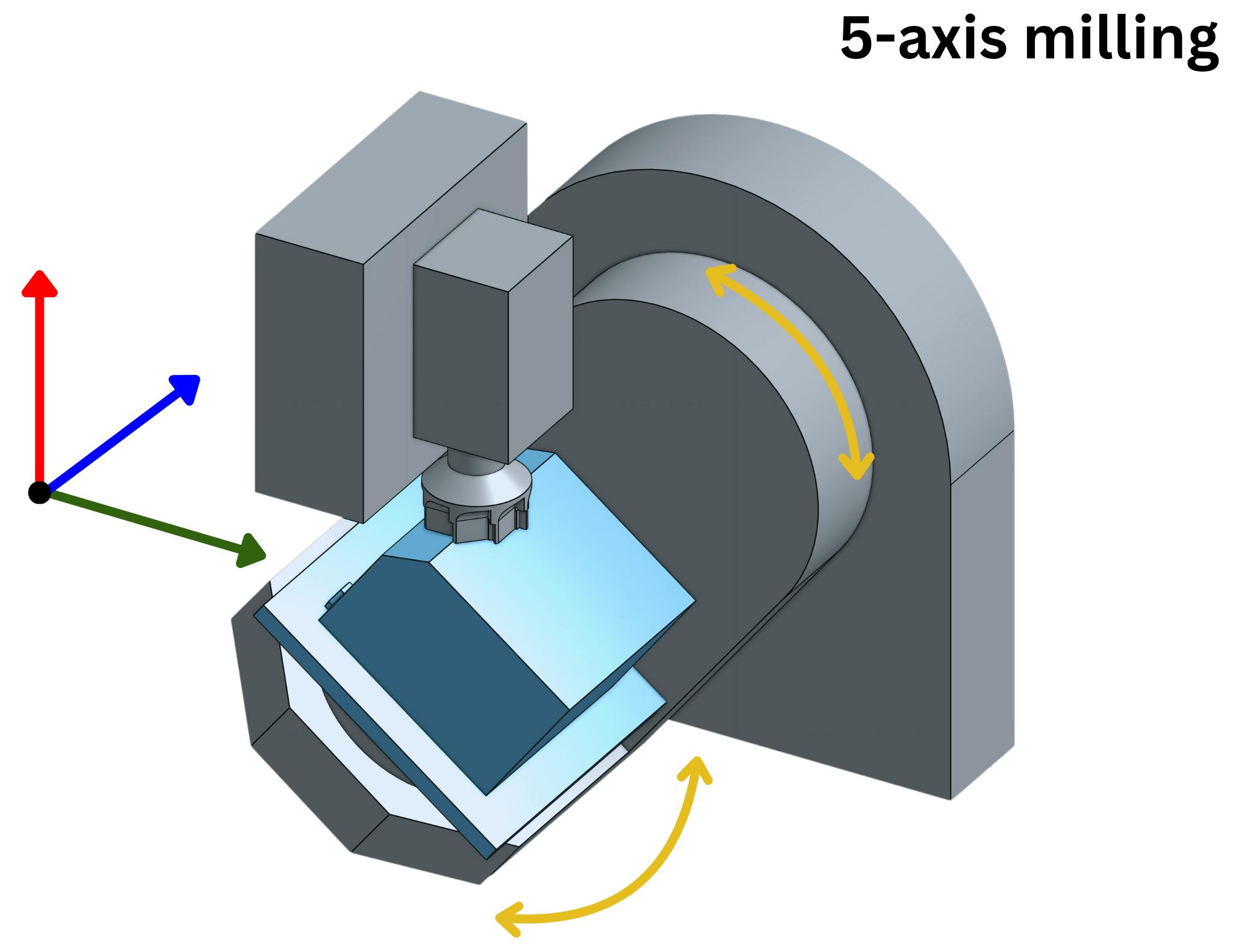
A 5-axis CNC machine adds two rotational axes (typically A and B or A and C) to the three linear axes (X, Y, Z) found in 3-axis CNC machines. This added flexibility allows the cutting tool or workpiece to move in multiple directions simultaneously, enabling the creation of more complex parts with fewer setups.
In essence, a 5-axis CNC machine can move the cutting tool or part along five axes - X, Y, Z for linear movement, plus the ability to rotate the tool or part along two additional axes (A and B, or A and C). This opens up new possibilities for intricate, multi-sided, and 3D machining that is difficult or impossible with just 3-axis motion.
What Can a 5‑Axis CNC Machine Do?
5-axis CNC machines are ideal for machining complex geometries, including parts with:
- Curved surfaces or contoured shapes that require continuous motion across multiple axes.
- Undercuts or multi-surfaced parts that are difficult to machine with only 3-axis movement.
- Turbine blades, aerospace components, molds, and other precision parts with intricate designs that demand high accuracy and fine surface finishes.
Due to the ability to position the part at various angles and orientations during the machining process, 5-axis CNC machines can reduce the number of setups and tool changes needed for complex parts, resulting in greater efficiency and accuracy.
Advantages and Limitations of 5‑Axis CNC
Advantages
- Increased Flexibility and Precision: The main advantage of 5-axis CNC machines is their ability to handle complex geometries with high precision. The added rotational axes allow the cutting tool to approach the part from virtually any angle, enabling more intricate cuts and finer surface finishes. This makes 5-axis CNC ideal for parts that require multi-dimensional shaping, such as aerospace, automotive, and medical components.
- Fewer Setups and Tool Changes: Traditional 3-axis CNC machines require multiple setups to machine parts on all sides, which can introduce errors or alignment issues. In contrast, 5-axis CNC machines allow for continuous, multi-axis movement, which means a part can be machined in fewer steps. This reduces the need for repositioning the part, tool changes, and multiple setups, improving efficiency and accuracy.
- Better Surface Finish and Higher Tolerances: Since 5-axis CNC machines can move along multiple axes simultaneously, they are able to achieve better surface finishes with fewer imperfections. These machines are ideal for high-precision applications where tight tolerances are critical, such as turbine blades, medical devices, and molds. The continuous cutting motion helps minimize tool marks and other surface defects.
- More Complex Part Designs: With 5-axis CNC, it’s possible to machine parts that would be extremely difficult or impossible to create with 3-axis CNC. This includes undercuts, intricate curves, or multi-sided components, all of which require simultaneous rotation and movement. Industries that demand these types of parts, such as aerospace, automotive, and medical, rely heavily on 5-axis CNC to meet their design and production needs.
Limitations
- Higher Cost (Machine + Operation): The complexity of 5-axis CNC machines comes at a price. Not only are the machines themselves more expensive to purchase, but they also require higher maintenance and more skilled operators. 5-axis machines have more components, which can increase both the initial investment and long-term operational costs. Additionally, the advanced nature of 5-axis programming may require specialized training.
- Complex Programming and Operation: Programming a 5-axis CNC machine is significantly more complex than a 3-axis CNC machine. Since the machine can move along five axes simultaneously, it requires advanced software and programming skills to ensure the part is machined correctly. This increases both the time and expertise required for setup and operation.
- Longer Setup Time for Complex Jobs: Although 5-axis CNC machines reduce the need for multiple setups during machining, the setup process itself can take longer due to the complexity of programming and tool selection. For simpler jobs, this added complexity may not justify the benefits, and a 3-axis CNC machine may be more cost-effective.
- Not Always Necessary for Simple Parts: For parts with basic designs that don’t require intricate shapes, tight tolerances, or multi-sided machining, 5-axis CNC machining can be overkill. In these cases, the added complexity and cost may not provide a significant benefit, making 3-axis CNC the more efficient choice.
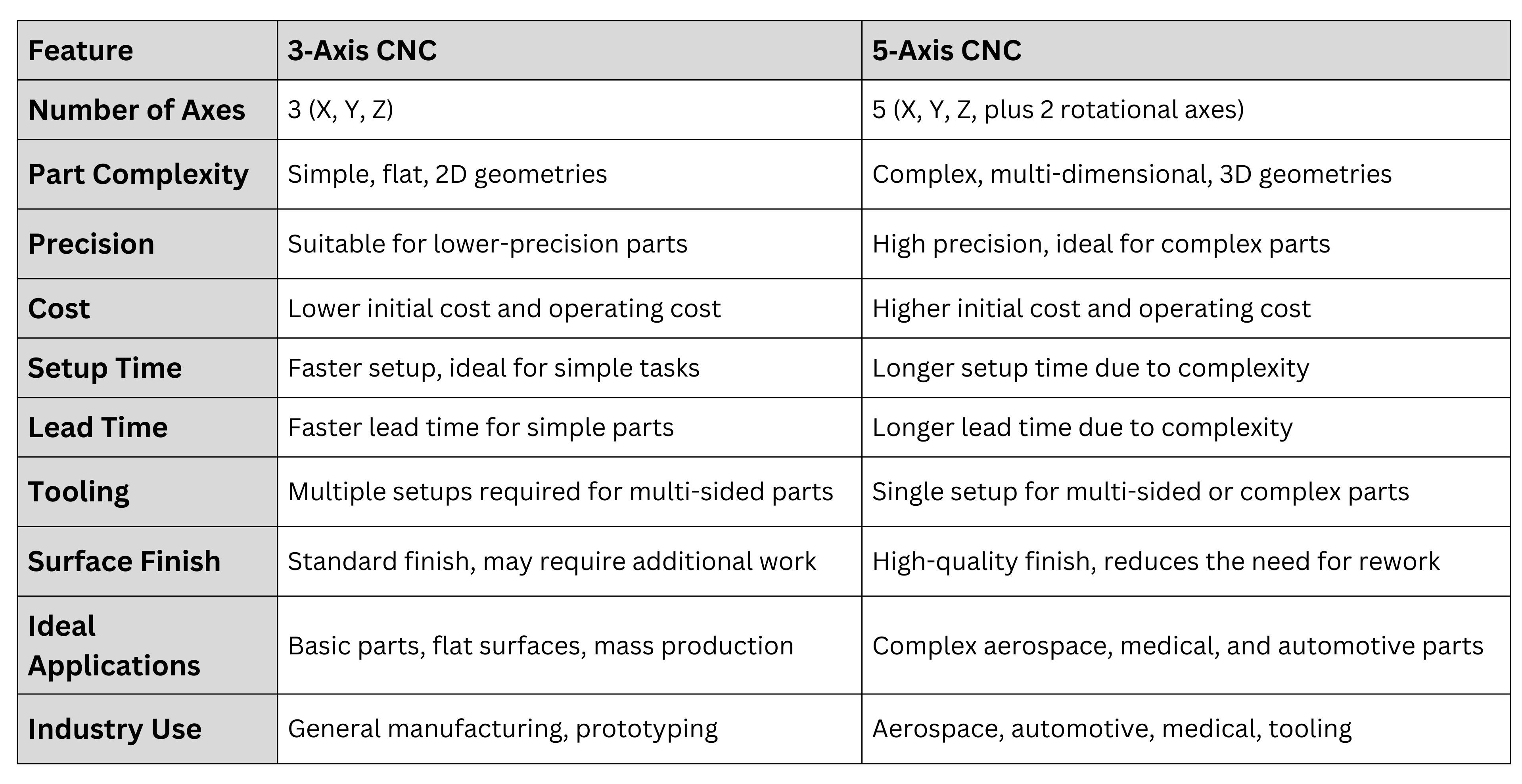
3-axis vs 5-axis cnc: What Is the Difference Between 3-Axis and 5-Axis CNC?
To help you better understand the distinctions between 3-axis CNC and 5-axis CNC, we’ve created a side-by-side comparison of the two machining methods. This will help you make an informed decision based on factors like part complexity, cost, lead time, and precision needs.
Making the Right Choice with Geomiq
Choosing between 3-axis CNC and 5-axis CNC depends on your project’s unique needs, whether that’s part complexity, cost, precision, or lead time. At Geomiq, we are committed to helping you make the right choice for your machining project. Request an instant quote now!
About the author
Sam Al-Mukhtar
Mechanical Engineer, Founder and CEO of Geomiq
Mechanical Engineer, Founder and CEO of Geomiq, an online manufacturing platform for CNC Machining, 3D Printing, Injection Moulding and Sheet Metal fabrication. Our mission is to automate custom manufacturing, to deliver industry-leading service levels that enable engineers to innovate faster.