ISO Certifications in CNC Manufacturing
What Is ISO Certification?
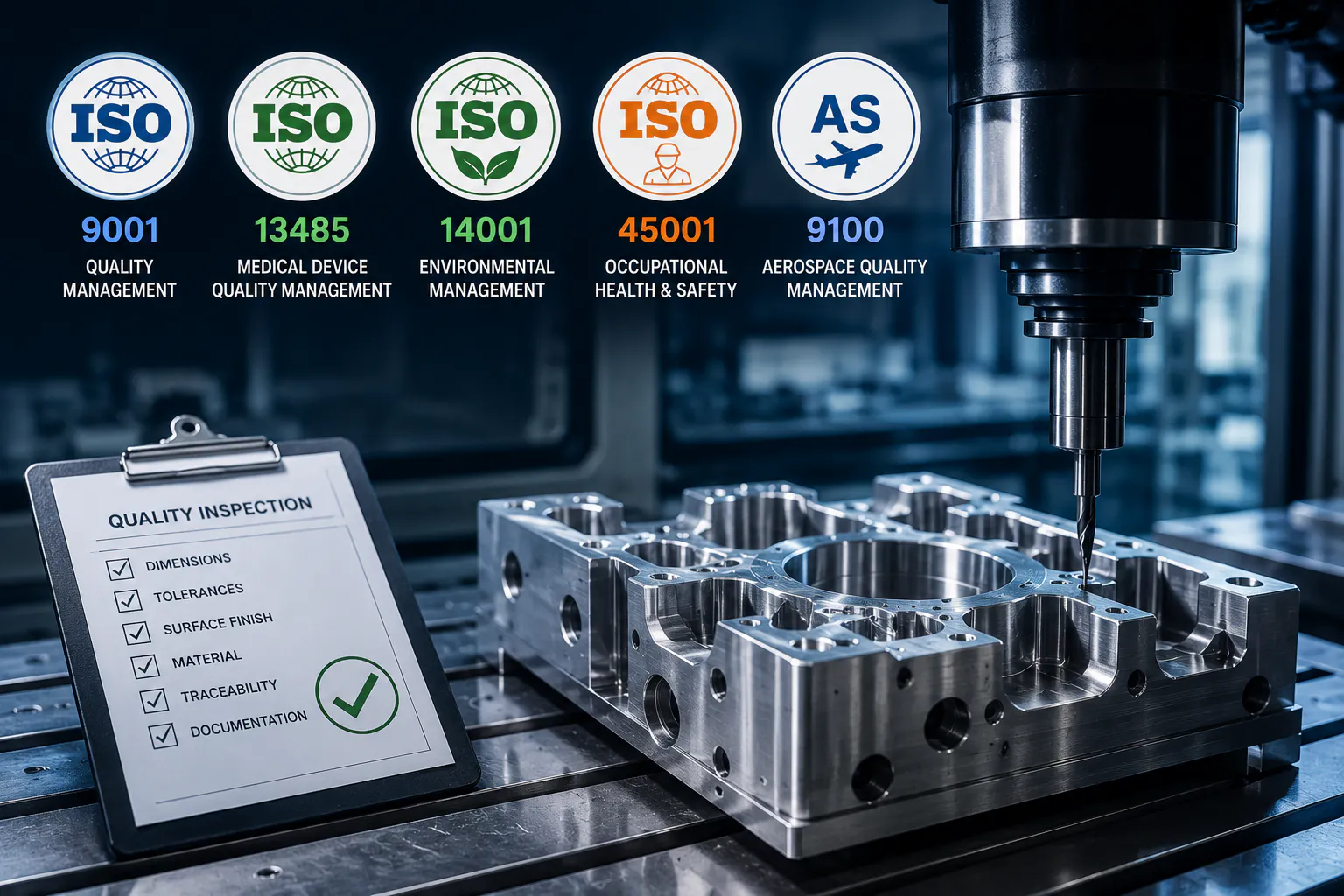
ISO certification shows that a company follows recognised standards for quality, safety, environmental responsibility, or industry-specific requirements. In manufacturing, it means there are clear processes in place, not just informal ways of working.
This is especially important in rapid manufacturing, where parts often need to be produced quickly without losing accuracy or consistency. Certification gives customers more confidence that orders are reviewed properly, production is controlled, and finished parts are checked before delivery.
Why ISO Certification Matters in CNC Manufacturing
In CNC manufacturing, small process errors can affect tolerance, surface finish, material performance, and final part usability. ISO certification helps reduce these risks by setting clear procedures for quality control, traceability, supplier management, and continuous improvement.
When choosing CNC machining services, ISO certification helps show that the supplier has a structured quality system in place. It gives engineers and procurement teams more confidence that parts will be made consistently, documented correctly, and checked against the required specifications.
How ISO Standards Support Quality, Compliance and Risk Control
Different standards support different areas of manufacturing. For example, the ISO 9001 standard focuses on quality management, while the ISO 13485 standard is more specific to medical device manufacturing. Other standards, such as ISO 14001 and ISO 45001, focus on environmental responsibility and workplace health and safety.
In practical terms, ISO standards can help manufacturers control:
- Quality risks by setting clear inspection and process control requirements
- Compliance risks by keeping records, documentation and traceability organised
- Production risks by improving consistency across different jobs and batches
- Supplier risks by creating better checks for materials, partners and subcontractors
- Customer risks by making requirements clearer before production begins
For engineers and procurement teams, this matters because CNC parts often need to meet exact functional, material or industry requirements. ISO certification does not mean every project is automatically risk-free, but it does show that the manufacturer has a structured system for identifying problems, reducing errors and improving processes over time.
Comparing the Most Important ISO Standards for Manufacturers
Different certifications support different parts of manufacturing, from quality control to safety, sustainability and sector-specific compliance. For CNC projects, the right standard depends on the industry, part risk, documentation needs and final application.
| Certification | Main Focus | Most Relevant For | Why It Matters in Manufacturing |
|---|---|---|---|
| ISO 9001 | Quality management | General manufacturing, CNC machining, prototyping and production | Helps ensure consistent processes, clear quality checks and continuous improvement. |
| ISO 13485 | Medical device quality management | Medical devices, healthcare products and regulated components | Supports stronger documentation, traceability and risk control for medical-related projects. |
| ISO 14001 | Environmental management | Manufacturers focused on sustainability and environmental responsibility | Helps control waste, resource use and environmental impact across operations. |
| ISO 45001 | Workplace health and safety | Manufacturing sites, workshops and production environments | Shows that health and safety risks are managed through a structured system. |
| AS9100 | Aerospace quality management | Aerospace, defence and high-performance engineering | Builds on ISO 9001 with stricter requirements for traceability, risk control and supplier management. |
ISO 9001? Quality Management System
ISO 9001 is an international quality management standard. It helps companies build clear processes for managing quality, customer requirements, documentation, supplier checks and continuous improvement.
In CNC manufacturing, this matters because every part needs to follow the correct specification. The goal of ISO 9001 is to make quality more consistent, from quote review and material selection to machining, inspection and delivery.
ISO 9001 Standard: Quality Management for Consistent Manufacturing
The ISO 9001 standard is not about checking one final part only. It focuses on the full quality system behind the work, including how a company reviews orders, controls production, handles non-conforming parts and improves its processes over time.
For CNC projects, this can help reduce errors in tolerances, materials, finishes and repeat production runs. It gives engineers and procurement teams more confidence that the manufacturer has a controlled way of working, not just skilled operators and good machines.
ISO 9001:2015 Certification at Geomiq

Geomiq holds ISO 9001:2015 certification, which supports its quality management approach across manufacturing services, including CNC machining. This means Geomiq works with structured quality systems designed to support reliable, repeatable production.
For customers ordering CNC parts, this is an important trust signal. It shows that Geomiq has processes in place for quality checks, documentation and supplier control, helping customers manage risk when producing prototypes, low-volume parts or production components.
ISO 13485: Medical Devices
ISO 13485 is a quality management standard for companies involved in the medical device industry. It focuses on controlled processes, documentation, traceability, risk management and consistent quality.
In CNC manufacturing, this is important when parts may be used in medical devices, equipment or regulated applications. ISO 13485 helps show that the manufacturer has a more controlled approach to quality, especially where precision, records and repeatability matter.
ISO 13485 Standard: Quality Management for Medical Device Manufacturing
The ISO 13485 standard is based on quality management principles, but it is more specific than ISO 9001. It places stronger focus on regulatory requirements, risk control, documentation and traceability throughout the manufacturing process.
For CNC machined medical components, this can support better control over material records, inspection steps and production consistency. It does not automatically mean every part is approved for medical use, but it shows that the quality system is designed to support more demanding manufacturing requirements.
ISO 13485 Certification at Geomiq

Geomiq holds ISO 13485 certification, which is especially relevant for customers working on medical devices, healthcare products or regulated engineering projects. This certification supports a structured approach to quality, documentation and process control.
For teams ordering CNC parts, it adds another layer of confidence beyond general quality management. It shows that Geomiq can support projects where accuracy, traceability and reliable production processes are especially important.
Other Relevant Manufacturing Certifications to Know
Beyond ISO 9001 and ISO 13485, there are other certifications that may be important depending on the industry, part application and project requirements. In manufacturing, certifications often help customers understand how a supplier manages quality, environmental responsibility, safety and sector-specific risks.
For CNC projects, these standards can be useful when parts are used in regulated or high-responsibility sectors. They do not all apply to every job, but they can help engineers and procurement teams choose the right manufacturing partner for more demanding applications.
ISO 14001 Certification: Environmental Management
ISO 14001 certification focuses on environmental management. It helps companies manage their environmental impact through better control of waste, energy use, materials and operational processes.
For manufacturing companies, ISO 14001 can be important because CNC machining, material sourcing and production waste all have environmental considerations. It shows that a company has a structured system for reducing environmental risk and improving sustainability over time.
ISO 45001 Certification: Workplace Health and Safety
ISO 45001 certification focuses on occupational health and safety. It helps companies create safer working environments by identifying risks, improving procedures and reducing the chance of workplace incidents.
In CNC manufacturing, safety is important because teams work with machinery, tooling, materials and production equipment every day. The ISO 45001 standard shows that a company has a formal system for managing health and safety responsibilities.
AS 9100 Certification: Aerospace Quality Management
AS9100 certification is a quality management certification used in the aerospace industry. It is based on ISO 9001 but includes additional requirements for safety, traceability, risk control and supplier management.
The AS9100 standard is especially relevant when CNC machined parts are used in aerospace or other high-performance applications. It helps show that a manufacturer can meet stricter quality expectations where reliability, documentation and process control are critical.
Which ISO Certification Matters Most for Your Project?
ISO 9001 certification is often the most relevant because it focuses on consistent quality management and controlled production processes. Certification is granted through accredited organizations, including UKAS, which oversee compliance with international standards.
For medical or healthcare-related parts, ISO 13485 certification becomes more important because it supports stronger documentation, traceability and risk control. If the project is linked to environmental requirements, workplace safety or aerospace applications, then ISO 14001, ISO 45001 or AS9100 certification may also be relevant.
For engineers and procurement teams choosing CNC suppliers, the key point is to match the certification to the project risk. A simple prototype may only need a reliable quality process, while regulated or safety-critical CNC machined parts may require more specific certification and documentation.
FAQ
Do I need an ISO-certified supplier for one-off CNC prototypes?
Can an ISO-certified CNC supplier guarantee that every part will pass inspection?
Should I ask for inspection reports when ordering CNC machined parts?
Is ISO 13485 only needed for finished medical devices?
What should engineers check besides ISO certification?
About the author
Sam Al-Mukhtar
Mechanical Engineer, Founder and CEO of Geomiq
Mechanical Engineer, Founder and CEO of Geomiq, an online manufacturing platform for CNC Machining, 3D Printing, Injection Moulding and Sheet Metal fabrication. Our mission is to automate custom manufacturing, to deliver industry-leading service levels that enable engineers to innovate faster.