Bevel Meaning։ What Is a Bevel in CNC Machining?
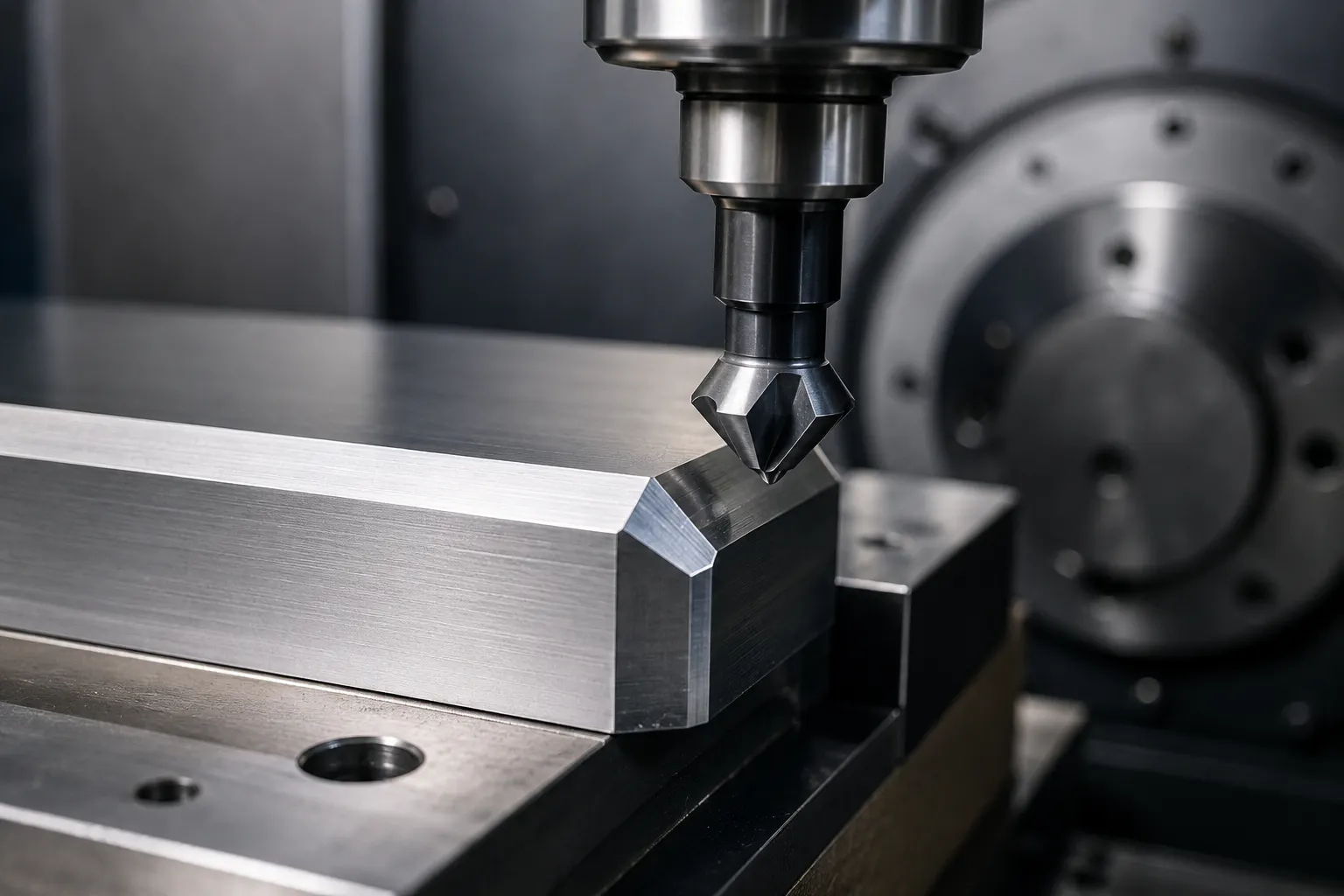
In CNC machining, a bevel is an angled edge or surface cut into a part instead of leaving the edge square. The simplest bevel definition is a sloped transition between two faces, often used to remove sharp edges, improve fit or prepare a part for assembly.
When people ask “what is a bevel?” in a machining context, they are usually referring to a controlled angled cut created with CNC milling, turning or a dedicated bevel tool. A part is described as beveled when one or more of its edges have been cut at a specific angle rather than left flat or sharp.
What Is a Beveled Cut in CNC Machining?
A beveled cut is an angled cut made across the edge, face or end of a machined component. In CNC machining, bevel cutting is typically used to create a precise edge transition, improve part handling, support assembly fit-up or prepare a surface for welding, fastening or further finishing.
Unlike a simple deburred edge, a beveled cut is usually defined by a specific bevel angle, width or depth in the CAD model or engineering drawing. For engineers working within rapid manufacturing workflows, clearly specifying these details helps reduce ambiguity during quoting, toolpath generation and production planning.
How Bevel Cutting Works in CNC Milling and Turning
Bevel cutting in CNC machining is produced by controlling the toolpath, tool angle and cutting depth to remove material at a defined angle. In CNC milling, bevels are commonly created using chamfer mills, angle cutters or multi-axis toolpaths, especially on edges, pockets and complex profiles. In CNC turning, bevels are typically produced on cylindrical components by feeding the cutting tool across the part edge at a specified angle. The method depends on the part geometry, required bevel angle, material and tolerance requirements.
| CNC process | Where bevels are added | Common tooling | Best suited for |
|---|---|---|---|
| CNC milling | Edges, faces, pockets | Chamfer mill, angle cutter | Prismatic parts |
| CNC turning | Ends, diameters, shoulders | Turning insert, form tool | Cylindrical parts |
| Multi-axis CNC | Complex angled surfaces | Ball/end mill toolpaths | Complex geometries |
What Is a Bevel Angle?
A bevel angle is the measured angle between the beveled surface and the original face or edge of the part. In CNC machining, the bevel angle must be clearly defined because it directly affects tool selection, machining strategy, edge geometry and final part fit.
When engineers ask “what is a bevel angle?”, they are usually referring to the controlled slope used to create a beveled cut. Common bevel angles include 30°, 45° and 60°, but the correct angle depends on the component function, mating parts, assembly requirements and any finishing or welding process that follows machining.
Types of Bevels in CNC Machining
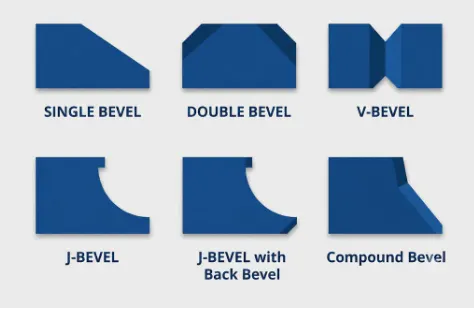
Different types of bevels are used depending on the part geometry, functional requirement and manufacturing process. In CNC machining, the bevel type should be specified clearly in the CAD model or engineering drawing to avoid interpretation issues during production.
Single Bevel
A single bevel is an angled cut applied to one side or one edge of a component. It is commonly used to remove sharp edges, improve assembly clearance or prepare a surface for joining, while keeping the opposite side square or unchanged.
Double Bevel
A double bevel uses angled cuts on both sides of an edge or feature. This creates a more symmetrical edge profile and can be useful when the part needs balanced edge geometry, improved stress distribution or clearance on both mating sides.
V-Bevel
A V-bevel is formed when two opposing angled cuts create a V-shaped profile. In CNC machining, this type of bevel is often used where accurate joint preparation, weld preparation or controlled edge alignment is required.
J-Bevel
A J-bevel has a curved or radius-like transition combined with an angled edge, creating a J-shaped profile. It is more complex than a standard straight bevel and may require careful toolpath planning, specialist tooling or multi-axis machining depending on the part geometry.
J-Bevel with Back Bevel
A J-bevel with back bevel combines a curved J-shaped bevel on one side with a smaller angled bevel on the opposite side. It is often used for thicker components where joint preparation, weld access or controlled edge geometry is required.
Compound Bevel
A compound bevel uses two or more angled surfaces on the same edge or feature. In CNC machining, it is typically used when a part needs specific clearance, fit-up or functional edge geometry that cannot be achieved with a single bevel angle.
| Bevel type | Basic form | Common CNC use | Complexity |
|---|---|---|---|
| Single bevel | One angled edge | Clearance, edge removal, fit-up | Low |
| Double bevel | Angles on both sides | Balanced edges, joint preparation | Medium |
| V-Bevel | Two cuts forming a V | Weld prep, alignment, joining | Medium |
| J-Bevel | Curved bevel profile | Thick parts, controlled joints | High |
| J-Bevel with back bevel | J-profile plus rear bevel | Weld access, penetration control | High |
| Compound bevel | Multiple bevel angles | Complex fit, clearance, function | High |
Common Bevel Tools Used in CNC Machining
The most common bevel tool in CNC machining is a chamfer mill, which is used to create controlled angled edges, edge breaks and simple beveled cuts. Angle cutters, countersinks, form tools and turning inserts may also be used depending on the bevel angle, part geometry and machining process. For more complex bevel cutting, especially on contoured or multi-sided features, CNC programmers may use ball end mills, tapered cutters or multi-axis toolpaths to achieve the required profile. The right tool choice depends on material, tolerance, surface finish and how accessible the beveled feature is during machining.
Bevel vs Chamfer: What Is the Difference?
A bevel and a chamfer are closely related, but they are not always used in the same way in CNC machining. A chamfer is usually a small, straight angled edge used for edge breaking, assembly or deburring, while a bevel is often a larger or more functional angled surface with a defined purpose, angle or joint requirement.
| Feature | Bevel | Chamfer | CNC Use |
|---|---|---|---|
| Size | Often larger | Usually smaller | Edge control |
| Purpose | Fit, weld, function | Deburr, assemble | Part finishing |
| Geometry | Angled surface | Straight edge cut | Simple toolpath |
| Specification | Angle + width/depth | Often 45° | Drawing clarity |
Advantages of Beveling in CNC Machining
Beveling in CNC machining helps remove sharp edges, improve part safety and support smoother assembly. A controlled beveled cut can also improve fit-up between mating components, prepare edges for welding or finishing, and reduce the risk of edge damage during handling. For functional parts, beveling can provide better clearance, cleaner transitions and more reliable performance in the final assembly.
Disadvantages and Limitations of Beveled Cuts
Beveled cuts can add complexity when the angle, depth or feature location requires additional tooling or more advanced toolpaths. They may also be difficult to machine consistently on thin walls, internal features or areas with limited tool access. If the bevel definition is unclear on the drawing, it can lead to quoting delays, interpretation issues or parts that do not meet the intended design requirement.
Why Beveled Edges Matter for CNC Machined Parts
Beveled edges matter because they often affect how a CNC machined part fits, functions and performs in use. A well-defined bevel can help reduce sharp-edge risks, improve assembly alignment and create a more controlled transition between surfaces. In precision components, even a small beveled edge can influence handling, fastening, sealing or contact with neighbouring parts.
When Beveling Can Increase CNC Machining Cost
Beveling can increase CNC machining cost when the feature requires specialist tooling, tight angular tolerances, multi-axis machining or extra setups. Costs can also rise when beveled cuts are placed in hard-to-reach areas, on complex geometries or across multiple faces of the same part. The more specific the bevel angle, surface finish and dimensional control, the more machining time and inspection may be required.
From Bevel Design to CNC Manufacturability
Beveling may look like a small edge detail, but it can affect CNC manufacturability, tool access, machining time and final part performance. Defining the bevel angle, bevel type and required tolerance clearly helps reduce ambiguity during quoting and ensures the part can be produced efficiently.
At Geomiq, engineers and procurement teams can upload CAD files for rapid manufacturing support and CNC machining quotes, helping them move from design review to production with fewer delays. Whether you need a simple beveled cut, a functional edge feature or a more complex bevel geometry, clear design intent helps achieve better results from the first quote.
FAQs
Do I need to specify the bevel angle on my CNC drawing?
Is a 45-degree bevel always the best option?
Can beveling be added after CNC machining?
Why did my CNC quote increase after adding beveled edges?
Should I use a bevel or chamfer for sharp edge removal?
About the author
Sam Al-Mukhtar
Mechanical Engineer, Founder and CEO of Geomiq
Mechanical Engineer, Founder and CEO of Geomiq, an online manufacturing platform for CNC Machining, 3D Printing, Injection Moulding and Sheet Metal fabrication. Our mission is to automate custom manufacturing, to deliver industry-leading service levels that enable engineers to innovate faster.