Standard Drill Bit Sizes for CNC Machining
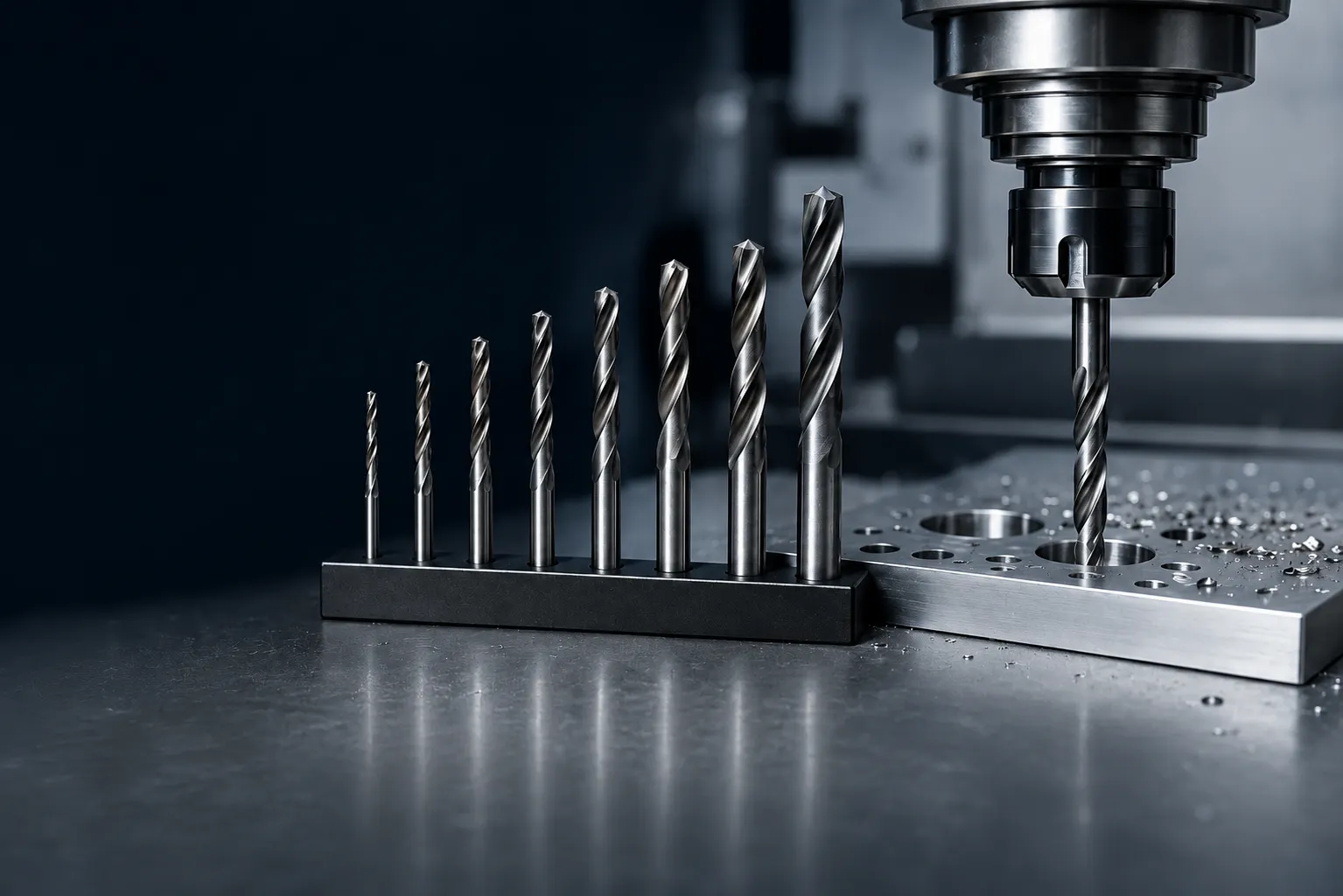
Drill Bit Sizes in CNC Machining
Choosing a non-standard hole size may seem like a small design detail, but it can quickly affect CNC machining cost and lead time. If the hole does not match a standard drill bit size, it may need an extra operation such as boring, reaming or milling instead of simple drilling.
This guide brings together practical drill bit size charts for CNC machining, including standard drill bit sizes in mm, number drill sizes, conversion tables, tap drill sizes and clearance hole dimensions. Use it to check common sizes early, avoid unnecessary machining steps and make your CAD file easier to quote and manufacture through a rapid manufacturing workflow.
Why Drill Bit Size Matters in CNC Machining
Drill bit size directly affects hole accuracy, thread quality, assembly fit and overall part performance. If the wrong size is selected, the hole may be too tight, too loose or unsuitable for the required fastener.
For CNC Machining Services, using the right drill bit size also helps control machining time and cost. Standard drill bit sizes, tapping drill sizes and clearance hole charts make it easier to choose the correct option before sending a design for production.
CNC Drilling DFM Rules
Good DFM starts with choosing hole sizes that match standard CNC drill bit sizes. For most CNC machined parts, try to keep drilled holes at 2.5–3 mm minimum diameter where possible, especially in harder materials or deeper features.
As a general rule, drilled hole depth should stay within 10× the hole diameter unless the design requires specialist deep-hole drilling. Standard metric increments such as 0.1 mm are easier to quote and machine, while unusual diameters may require extra tooling, interpolation, reaming or boring.
| DFM Rule | Recommended Guideline | Why It Matters |
|---|---|---|
| Minimum standard drilled hole | 2.5–3 mm | Reduces tool breakage risk |
| Maximum drilled depth | Up to 10× diameter | Helps control deflection and chip removal |
| Preferred metric increment | 0.1 mm | Matches common CNC drill sizes |
| Tight precision holes | Ream or bore after drilling | Improves final tolerance |
| Non-standard diameters | Avoid unless required | Can increase cost and lead time |
Standard Drill Bit Sizes: Quick Reference Table
This quick drill bit sizes chart shows common metric drill sizes used in CNC machining. Use it as a starting point when checking hole sizes, tapping requirements or standard bit sizes before moving to a more detailed drill bit size table.
| Drill Bit Size | Decimal Inch Equivalent | Typical CNC Use |
|---|---|---|
| 1.0 mm | 0.0394" | Small pilot holes |
| 1.5 mm | 0.0591" | Small component holes |
| 2.0 mm | 0.0787" | Pilot holes, light fasteners |
| 2.5 mm | 0.0984" | Small clearance holes |
| 2.8 mm | 0.1102" | M3 tapping drill size |
| 3.0 mm | 0.1181" | General small holes |
| 3.2 mm | 0.1260" | M3 clearance holes |
| 3.3 mm | 0.1299" | M4 tapping drill size |
| 4.0 mm | 0.1575" | Standard clearance holes |
| 4.2 mm | 0.1654" | M5 tapping drill size |
| 5.0 mm | 0.1969" | General CNC drilling |
| 5.5 mm | 0.2165" | M5/M6 clearance holes |
| 6.0 mm | 0.2362" | Medium clearance holes |
| 6.8 mm | 0.2677" | M8 tapping drill size |
| 8.0 mm | 0.3150" | Larger drilled holes |
| 8.5 mm | 0.3346" | M10 tapping drill size |
| 10.0 mm | 0.3937" | Larger clearance holes |
| 10.2 mm | 0.4016" | M12 tapping drill size |
| 12.0 mm | 0.4724" | Larger CNC drilled holes |
Standard Drill Bit Sizes in mm
Standard drill bit sizes in mm are commonly used in UK and European CNC machining because they align with metric drawings, fasteners and thread specifications. Using metric bit sizes makes it easier to select the right drill for clearance holes, tapping holes and general machining requirements.
A drill bit sizes chart in millimetres can help engineers quickly compare common sizes and avoid specifying non-standard holes that may require extra machining time.
Number Size Drill Chart
A number size drill chart is used for small drill bit sizes, especially where precise hole diameters are needed. These number drill sizes are often used in CNC machining, electronics, small fasteners and detailed engineering work.
Unlike metric bit sizes, number drill sizes run in reverse order: a #80 drill is very small, while a #1 drill is much larger. The drill bit size table below shows common number drill sizes with their decimal inch and mm equivalents.
| Number Drill Size | Decimal Inch | Metric Equivalent |
|---|---|---|
| #80 | 0.0135" | 0.343 mm |
| #79 | 0.0145" | 0.368 mm |
| #78 | 0.0160" | 0.406 mm |
| #77 | 0.0180" | 0.457 mm |
| #76 | 0.0200" | 0.508 mm |
| #75 | 0.0210" | 0.533 mm |
| #74 | 0.0225" | 0.572 mm |
| #73 | 0.0240" | 0.610 mm |
| #72 | 0.0250" | 0.635 mm |
| #71 | 0.0260" | 0.660 mm |
| #70 | 0.0280" | 0.711 mm |
| #69 | 0.0292" | 0.742 mm |
| #68 | 0.0310" | 0.787 mm |
| #67 | 0.0320" | 0.813 mm |
| #66 | 0.0330" | 0.838 mm |
| #65 | 0.0350" | 0.889 mm |
| #64 | 0.0360" | 0.914 mm |
| #63 | 0.0370" | 0.940 mm |
| #62 | 0.0380" | 0.965 mm |
| #61 | 0.0390" | 0.991 mm |
| #60 | 0.0400" | 1.016 mm |
| #59 | 0.0410" | 1.041 mm |
| #58 | 0.0420" | 1.067 mm |
| #57 | 0.0430" | 1.092 mm |
| #56 | 0.0465" | 1.181 mm |
| #55 | 0.0520" | 1.321 mm |
| #54 | 0.0550" | 1.397 mm |
| #53 | 0.0595" | 1.511 mm |
| #52 | 0.0635" | 1.613 mm |
| #51 | 0.0670" | 1.702 mm |
| #50 | 0.0700" | 1.778 mm |
| #49 | 0.0730" | 1.854 mm |
| #48 | 0.0760" | 1.930 mm |
| #47 | 0.0785" | 1.994 mm |
| #46 | 0.0810" | 2.057 mm |
| #45 | 0.0820" | 2.083 mm |
| #44 | 0.0860" | 2.184 mm |
| #43 | 0.0890" | 2.261 mm |
| #42 | 0.0935" | 2.375 mm |
| #41 | 0.0960" | 2.438 mm |
| #40 | 0.0980" | 2.489 mm |
| #39 | 0.0995" | 2.527 mm |
| #38 | 0.1015" | 2.578 mm |
| #37 | 0.1040" | 2.642 mm |
| #36 | 0.1065" | 2.705 mm |
| #35 | 0.1100" | 2.794 mm |
| #34 | 0.1110" | 2.819 mm |
| #33 | 0.1130" | 2.870 mm |
| #32 | 0.1160" | 2.946 mm |
| #31 | 0.1200" | 3.048 mm |
| #30 | 0.1285" | 3.264 mm |
| #29 | 0.1360" | 3.454 mm |
| #28 | 0.1405" | 3.569 mm |
| #27 | 0.1440" | 3.658 mm |
| #26 | 0.1470" | 3.734 mm |
| #25 | 0.1495" | 3.797 mm |
| #24 | 0.1520" | 3.861 mm |
| #23 | 0.1540" | 3.912 mm |
| #22 | 0.1570" | 3.988 mm |
| #21 | 0.1590" | 4.039 mm |
| #20 | 0.1610" | 4.089 mm |
| #19 | 0.1660" | 4.216 mm |
| #18 | 0.1695" | 4.305 mm |
| #17 | 0.1730" | 4.394 mm |
| #16 | 0.1770" | 4.496 mm |
| #15 | 0.1800" | 4.572 mm |
| #14 | 0.1820" | 4.623 mm |
| #13 | 0.1850" | 4.699 mm |
| #12 | 0.1890" | 4.801 mm |
| #11 | 0.1910" | 4.851 mm |
| #10 | 0.1935" | 4.915 mm |
| #9 | 0.1960" | 4.978 mm |
| #8 | 0.1990" | 5.055 mm |
| #7 | 0.2010" | 5.105 mm |
| #6 | 0.2040" | 5.182 mm |
| #5 | 0.2055" | 5.220 mm |
| #4 | 0.2090" | 5.309 mm |
| #3 | 0.2130" | 5.410 mm |
| #2 | 0.2210" | 5.613 mm |
| #1 | 0.2280" | 5.791 mm |
Drill Bit Size Conversion Table
A drill bit size conversion table helps engineers compare imperial bit sizes with standard drill bit sizes in mm. This is useful when working with older drawings, supplier specifications or CNC drill bit sizes listed in inches.
The chart below shows common fractional drill bit sizes, their decimal inch value and the closest metric equivalent. Always check the required tolerance before choosing the nearest standard drill size for CNC machining.
| Fractional Drill Size | Decimal Inch | Exact Size in mm | Nearest Standard Metric Size |
|---|---|---|---|
| 1/64" | 0.0156" | 0.397 mm | 0.4 mm |
| 1/32" | 0.0313" | 0.794 mm | 0.8 mm |
| 3/64" | 0.0469" | 1.191 mm | 1.2 mm |
| 1/16" | 0.0625" | 1.588 mm | 1.6 mm |
| 5/64" | 0.0781" | 1.984 mm | 2.0 mm |
| 3/32" | 0.0938" | 2.381 mm | 2.4 mm |
| 7/64" | 0.1094" | 2.778 mm | 2.8 mm |
| 1/8" | 0.1250" | 3.175 mm | 3.2 mm |
| 9/64" | 0.1406" | 3.572 mm | 3.6 mm |
| 5/32" | 0.1563" | 3.969 mm | 4.0 mm |
| 11/64" | 0.1719" | 4.366 mm | 4.4 mm |
| 3/16" | 0.1875" | 4.763 mm | 4.8 mm |
| 13/64" | 0.2031" | 5.159 mm | 5.2 mm |
| 7/32" | 0.2188" | 5.556 mm | 5.6 mm |
| 15/64" | 0.2344" | 5.953 mm | 6.0 mm |
| 1/4" | 0.2500" | 6.350 mm | 6.4 mm |
| 5/16" | 0.3125" | 7.938 mm | 8.0 mm |
| 3/8" | 0.3750" | 9.525 mm | 9.5 mm |
| 7/16" | 0.4375" | 11.113 mm | 11.1 mm |
| 1/2" | 0.5000" | 12.700 mm | 12.7 mm |
How to Choose the Right CNC Drill Bit Size
Choosing the right CNC drill bit size depends on the purpose of the hole and the final function of the part. A tapping hole needs a smaller drill size before the thread is cut, while a clearance hole needs a larger diameter so the screw or bolt can pass through easily.
Engineers should also consider the material, hole depth, tolerance and whether the hole needs a standard drilled finish or a more precise operation such as reaming, boring or milling. For most CNC machining projects, using standard drill bit sizes in mm helps simplify production and reduce unnecessary tooling changes.
Before sending a CAD file for manufacturing, it is useful to check a drill bit sizes chart or drill bit size table to confirm that the selected hole size matches common CNC drill bit sizes. This helps improve manufacturability, reduce quoting delays and ensure the finished part meets the required fit and assembly conditions.
Next Steps with Geomiq
If you’re designing parts that must withstand real-world mechanical loads, Geomiq can support you with:
- Material selection guidance
- Precision manufacturing services
Engineering-ready production at scale
FAQ
Can I specify a non-standard drill bit size in my CAD drawing?
Why does the drilled hole sometimes come out slightly larger than the drill bit?
Should I add tolerances to every drilled hole?
What should I do if my part has very deep holes?
Can the same drill bit size be used for different materials?
About the author
Sam Al-Mukhtar
Mechanical Engineer, Founder and CEO of Geomiq
Mechanical Engineer, Founder and CEO of Geomiq, an online manufacturing platform for CNC Machining, 3D Printing, Injection Moulding and Sheet Metal fabrication. Our mission is to automate custom manufacturing, to deliver industry-leading service levels that enable engineers to innovate faster.