Sheet Metal Forming Techniques
Sheet metal forming is one of the core manufacturing processes used to transform flat sheet metal into functional three-dimensional parts. By applying controlled forces, the material is bent, stretched or drawn into the required geometry without intentionally removing material.
This guide explains how sheet metal forming works, the main forming processes and materials, important design and process parameters, and the factors engineers should consider when selecting the most suitable forming method for a part.
What is Sheet Metal Forming?
Sheet metal forming is a manufacturing process that reshapes flat sheet metal by applying forces that cause permanent plastic deformation. Unlike cutting or machining, forming changes the geometry of the sheet without intentionally removing material. It is a core sheet metal manufacturing process used to create bends, contours, cups, shells and other three-dimensional features from sheet stock.
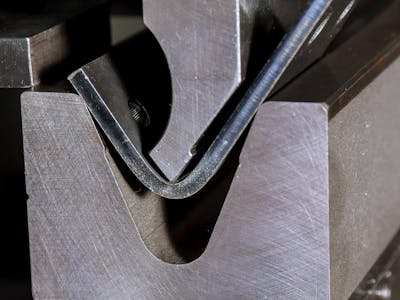
The formability of sheet metal depends on factors such as material ductility, yield strength, thickness, grain direction, tooling and part geometry. Common forming methods include bending, roll forming, deep drawing, stretch forming, spinning, hydroforming and forming operations performed in stamping presses. The most suitable process depends on the required geometry, material, production volume, tolerance requirements and tooling considerations.
Types of Materials Used in Sheet Metal Forming
Material selection has a major influence on sheet metal formability, manufacturing cost and final part performance. When choosing a material, engineers should consider factors such as ductility, strength, corrosion resistance, thickness, surface requirements and the conditions in which the finished part will operate. See our sheet metal materials guide for a broader comparison of commonly used materials.
- Stainless steel – Offers high strength and corrosion resistance, although formability varies by grade and condition. Austenitic grades such as 304 and 316 are commonly formed into components for food processing, medical equipment, architectural products and other corrosion-resistant applications. Grade 316 provides improved resistance in chloride-containing and more corrosive environments.
- Aluminium – Lightweight and corrosion-resistant, with a high strength-to-weight ratio. Many aluminium alloys offer good formability and are widely used for automotive, aerospace, electronics, enclosures and outdoor components. Formability depends on the specific alloy and temper.
- Hot-rolled steel – A cost-effective steel option commonly used where a highly refined surface finish or very tight dimensional control is not required. It is suitable for many structural and industrial sheet metal components and generally has a rougher surface and wider dimensional variation than cold-rolled steel.
- Cold-rolled steel – Provides a smoother surface finish and tighter dimensional control than typical hot-rolled sheet. It is commonly used for appliances, enclosures, automotive components and other applications where appearance, dimensional consistency or subsequent forming operations are important.
- Galvanised steel – Steel coated with zinc to improve corrosion resistance. It is commonly formed into roofing, HVAC components, enclosures, ductwork and other products that require additional protection against corrosion. Forming parameters should account for the coating to minimise cracking or damage during fabrication.
- Copper and copper alloys – Copper combines high electrical and thermal conductivity with good formability, making it suitable for electrical components, busbars, heat exchangers and architectural applications. Copper alloys such as brass offer different combinations of strength, corrosion resistance, formability and appearance depending on the application.
- High-strength low-alloy (HSLA) steel – Provides higher strength than many conventional low-carbon steels while retaining useful forming characteristics. Its higher strength can allow thinner sections to be used in some designs, helping reduce component weight. HSLA steels are commonly used in automotive, structural and heavy-equipment applications.
Sheet Metal Forming Processes
Sheet metal forming processes reshape flat sheet stock through controlled plastic deformation rather than material removal. Different processes use bending, tensile, compressive or combined forces to create specific geometries, and the appropriate method depends on factors such as part shape, material, thickness, tooling and production volume. Common sheet metal forming processes include bending, roll forming, curling, stamping, ironing, hydroforming, spinning, deep drawing and stretch forming.
Bending
Bending is one of the most common sheet metal forming processes and is used to create angles, flanges and other formed features by plastically deforming the sheet along a bend line. Press brakes are commonly used for bending, with the sheet positioned between an upper punch and lower die. As the punch applies force, the material deforms to the required angle and radius. The achievable bend depends on factors such as material, sheet thickness, bend radius, tooling and the bending method used. Typical applications include brackets, enclosures, panels, channels and other fabricated sheet metal components.
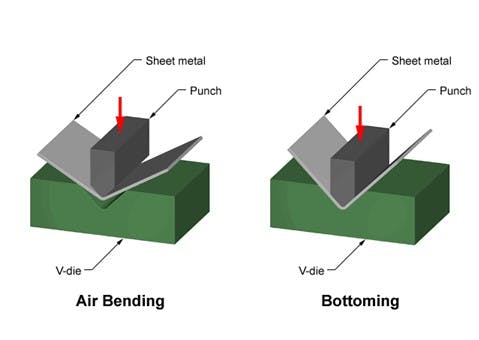
Common sheet metal bending methods include:
- V-bending: The sheet is positioned over a V-shaped die and formed by a punch. Depending on how deeply the material is pressed into the die, V-bending can be performed using methods such as air bending or bottoming.
- Air bending: The sheet contacts the punch tip and the die shoulders without being fully pressed against the die surfaces. Different bend angles can often be produced with the same tooling by controlling punch depth.
- Bottoming: The sheet is pressed more fully against the die surfaces, allowing the tooling geometry to define the bend more directly and generally providing greater dimensional consistency than air bending.
- Coining: A high-force bending method in which the punch compresses the material deeply into the die, producing localised plastic deformation. Coining can provide highly accurate bends and reduce springback, but it requires substantially higher forming forces than air bending.
- Roll bending: The sheet passes through a series of rollers that progressively bend it into curved or cylindrical shapes. It is commonly used for large-radius bends, cylinders, cones and other continuously curved components.
- Wipe bending: The sheet is held against a die or pressure pad while a wiping tool bends the unsupported edge around the die. This method is commonly used to form flanges and edge bends.
Roll Forming
Roll forming is a continuous sheet metal forming process in which flat sheet or strip passes through a series of contoured rollers. Each roll station progressively bends the material until the required cross-sectional profile is produced.
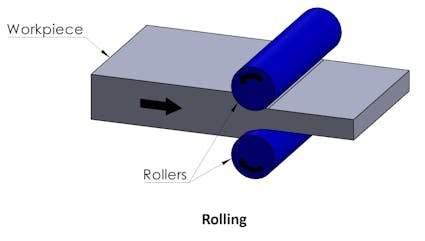
The process is particularly suitable for long components with a consistent cross-section and can produce profiles such as channels, rails, panels and structural sections. Roll forming is commonly used for roofing and cladding panels, automotive components, shelving, framing and other high-volume sheet metal products.
Because the material is shaped gradually across multiple roll stations, roll forming can produce complex profiles with good dimensional consistency while reducing the amount of deformation introduced at any single stage.
Curling
Curling is a sheet metal forming operation that rolls the edge of a sheet into a curved or hollow profile. The process can improve edge stiffness, remove exposed sharp edges and create a smoother, more finished edge without removing material. Curling is commonly used on products such as can edges, door and enclosure components, decorative trims and other parts that require reinforced or safer edges.
Stamping
Sheet metal stamping uses a press and dedicated tooling to form sheet metal into the required shape. A flat sheet or pre-cut blank is positioned in a stamping die, and the press applies controlled force to create the required features. Depending on the tooling, stamping can incorporate forming operations such as bending, drawing, flanging and embossing, and may also be combined with cutting operations such as punching or blanking.
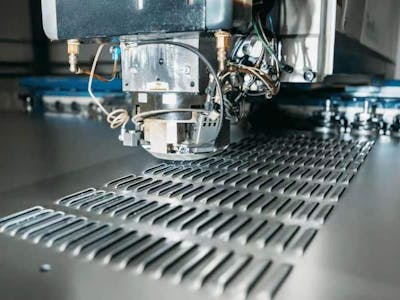
Stamping is particularly suitable for producing repeatable parts at medium to high volumes because dedicated tooling allows the same operations to be performed consistently across many components. Common applications include automotive panels and brackets, electrical components, appliance parts, enclosures and other sheet metal components that require repeatable geometry and efficient production.
Ironing
Ironing is a sheet metal forming operation used to reduce and control the wall thickness of a previously drawn component. The part is forced through a narrow clearance between a punch and die, which thins and lengthens the walls while helping achieve a more uniform thickness. Ironing is commonly used after deep drawing in the production of thin-walled containers such as aluminium beverage cans and similar cylindrical parts.

Hydroforming
Hydroforming uses pressurised fluid to form sheet metal against a die or tooling surface. The fluid pressure distributes forming force across the workpiece, allowing the sheet to conform to curved or complex geometries while reducing the need for matching rigid tooling in some hydroforming configurations.
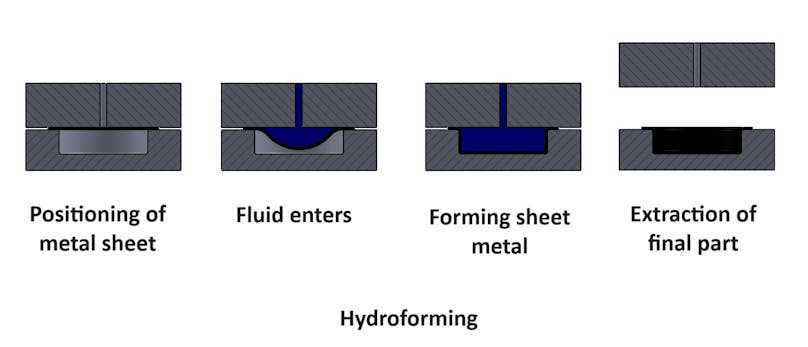
Sheet hydroforming is commonly used for automotive, aerospace and other engineered components where complex shapes, smooth contours or reduced numbers of joined parts are required. The achievable wall thickness, dimensional accuracy and forming limits depend on factors such as material properties, initial sheet thickness, pressure, tooling and part geometry. Hydroforming can reduce material waste and secondary operations for suitable components, although specialised equipment and tooling can increase initial manufacturing costs.
Spinning
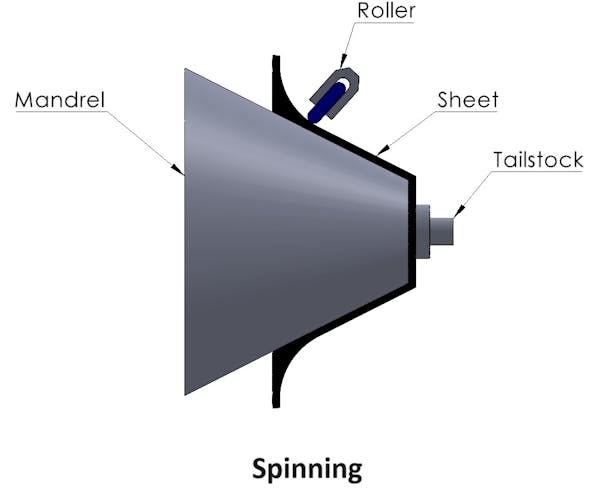
Metal spinning is a sheet metal forming process used to produce rotationally symmetrical parts. A flat circular blank is rotated against a mandrel while a roller applies controlled pressure, progressively forming the material to the required profile. Metal spinning is commonly used for parts such as cookware, lighting components, satellite dishes and other axisymmetric components.
Common spinning methods include:
- Conventional spinning: The roller gradually forms the rotating blank over the mandrel while largely maintaining the original sheet thickness. The final part follows the contour of the mandrel and typically has a smaller finished diameter than the original blank.
- Shear spinning: The roller forms the blank over the mandrel while intentionally reducing wall thickness. This allows the material to be stretched into a deeper profile while maintaining the general outer diameter of the blank.
Deep Drawing
Deep drawing is a sheet metal forming process used to produce hollow or cup-shaped parts from a flat blank. During the process, a punch draws the sheet metal into a shaped die cavity while a blank holder helps control material flow and reduce defects such as wrinkling.
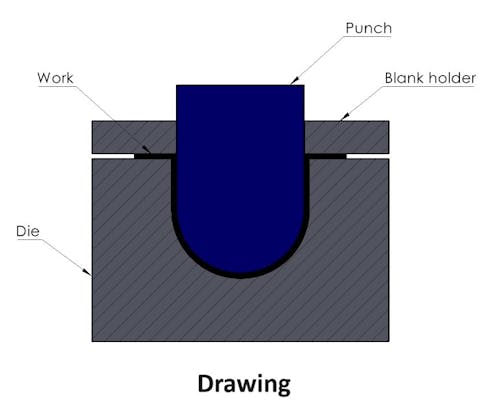
Hydraulic systems typically power this punch to exert sufficient force on the blank. Both the die and punch undergo wear due to the pressure exerted during the process, which is why they are constructed from durable materials like tool steel or carbon steel. Applications include automotive panels, kitchen sinks, and beverage cans.
Stretch Forming
Deep drawing can produce relatively deep components with continuous walls and is commonly used for products such as automotive components, kitchen sinks, housings, containers and beverage cans. The achievable depth and geometry depend on factors such as material formability, sheet thickness, punch and die geometry, lubrication, blank-holder force and the number of drawing stages required.
Stretch Forming
Stretch forming is a sheet metal forming process used to produce large, smooth, contoured parts. The sheet is clamped at its edges and placed under tension while it is stretched over a shaped die. This combination of tensile force and controlled forming allows the material to conform closely to the die while helping reduce wrinkling.
Stretch forming is commonly used for large curved components such as aircraft skins, automotive body panels and architectural parts. The achievable shape and dimensional accuracy depend on factors such as material formability, sheet thickness, tooling geometry, applied tension and the amount of stretch introduced during forming.
Important Parameters in Sheet Metal Forming
Several design and process parameters influence dimensional accuracy, formability and defect risk in sheet metal forming. Key factors include K-factor, bend radius, bend allowance, springback, tooling clearance and other process-specific forming conditions. Understanding these parameters helps engineers develop more accurate flat patterns, reduce forming defects and control manufacturing costs. See our guide on how to reduce sheet metal costs for additional design-for-manufacturing guidance.
K-Factor
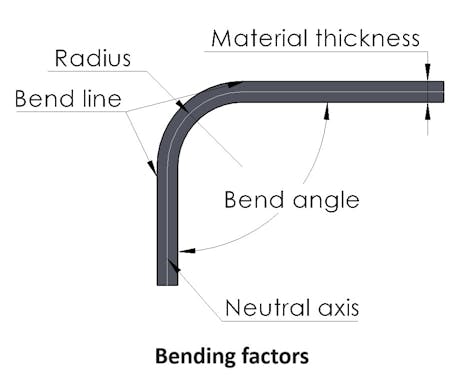
The K-factor is a ratio used in sheet metal bending to describe the position of the neutral axis through the material thickness. During bending, the outer surface of the sheet is stretched while the inner surface is compressed. Between them is the neutral axis, where the material experiences little or no longitudinal strain.
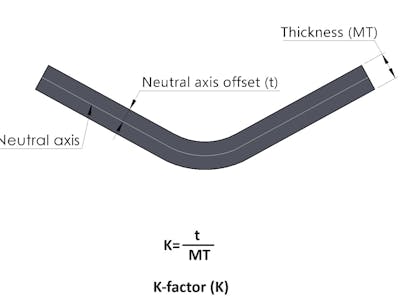
The K-factor is calculated as the distance from the inside bend surface to the neutral axis divided by the sheet thickness. It is used when calculating bend allowance and flat-pattern dimensions.
K = t / T
Where:
t = Distance from the inside bend surface to the neutral axis
T = Sheet thickness
There is no single universal K-factor for each material. The appropriate value depends on factors such as material, sheet thickness, bend radius, bend angle, tooling and the bending method used. For production parts, K-factor values should ideally be based on validated shop data, test bends or the bend tables used for the specific material and equipment.
Bend Radius (R)
The bend radius is the inside radius of a formed bend and is an important factor in sheet metal manufacturability. A radius that is too small for the selected material and thickness can increase localised strain and the risk of cracking, while larger radii generally reduce forming severity. The appropriate bend radius depends on factors such as material grade, sheet thickness, temper or condition, grain direction, tooling and the bending method used.
There is no single minimum bend radius that applies to every material within a category. Recommended values should be based on the specific grade, thickness, temper, grain direction, tooling and supplier or manufacturing guidelines. Where possible, designers should also use bend radii that match available tooling to reduce setup complexity and manufacturing cost.
Bend Deduction (BD) and Bend Allowance (BA)
Bend allowance is the length of the neutral axis through the bend and is used to calculate the flat-pattern length required to produce the finished part. Bend deduction represents the amount subtracted from the total flange dimensions to determine that flat length. Both values depend on factors such as bend angle, inside bend radius, material thickness and K-factor.
Formula:
Bend Allowance (BA):
BA = θ × (R + K × T)
Bend Deduction (BD):
BD = 2 × (R + T) × tan(θ / 2) − BA
Where:
θ = Bend angle through which the sheet is formed, in radians
R = Inside bend radius
K = K-factor
T = Material thickness
Springback
Springback is the elastic recovery that occurs after the forming force is removed, causing a sheet metal part to move slightly away from the intended geometry. The amount of springback depends on factors such as material strength and elastic behaviour, sheet thickness, bend radius, part geometry and the forming process used. Higher-strength materials generally exhibit greater springback and may require additional compensation during tooling or process design.
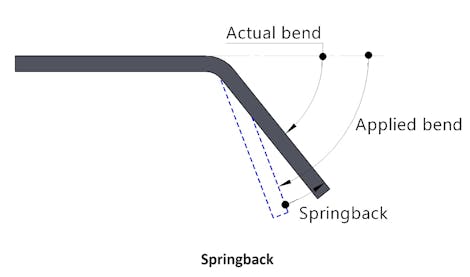
Manufacturers can compensate for springback using methods such as controlled overbending, tooling adjustments or process simulation and validation. The appropriate compensation depends on the specific material, geometry and forming conditions, so production data or test bends are often used to achieve the required final dimensions.
Die Clearance
Die clearance is the gap between the punch and die and must be selected according to the specific sheet metal operation. In cutting operations such as punching, the clearance influences cut quality, burr formation, punching force and tool life. In forming operations such as deep drawing, punch-to-die clearance affects material flow, wall thickness and the risk of defects such as tearing or wrinkling.
There is no single die-clearance value or formula that applies to all sheet metal forming processes. The appropriate clearance depends on the operation, material, sheet thickness, tooling geometry and required part quality. Designers and manufacturers should therefore use process-specific tooling recommendations or validated production data rather than applying one universal clearance percentage.
Sheet Metal Forming Considerations
Several material, dimensional, loading and design factors influence the success of a sheet metal forming process. Evaluating these considerations before production can help reduce defects, improve dimensional consistency and select a more suitable forming method for the part. Geomiq provides sheet metal fabrication services for custom components across a range of forming and fabrication requirements.
1. Material Considerations
Material properties directly affect how a sheet behaves during forming and the amount of deformation it can withstand before defects occur. Important considerations include ductility, grain direction and material condition.
Ductility
Ductility describes a material’s ability to undergo plastic deformation before fracture. Materials with higher ductility generally tolerate greater forming strains and are less likely to crack during operations such as bending, drawing or stretching. However, formability depends on more than ductility alone and is also influenced by material strength, thickness, microstructure and the specific forming mode.
Grain Direction (Anisotropy)
Rolling creates directional properties in sheet metal, so grain orientation can affect bendability and cracking risk. For many sheet materials, bends are generally more resistant to cracking when the bend line is oriented perpendicular to the grain direction, while bending parallel to the grain can increase the risk of fracture, particularly with tighter radii or less ductile materials. Grain direction should therefore be considered together with material grade, thickness and bend radius when laying out formed features.
Heat Treatment
Heat treatment and prior processing can significantly affect sheet metal strength, hardness, ductility and residual stress. Annealed or softer material conditions are often easier to form, while hardened or heavily cold-worked materials may require higher forming forces and can have lower available ductility. The effect depends on the alloy, temper or condition and the forming process used.
2. Size Considerations
Sheet thickness, overall blank dimensions and part geometry influence the forming force, tooling requirements, material flow and achievable shape during sheet metal forming. These factors should be considered together with the selected material and forming process.
Thickness
Sheet thickness directly affects the force required for forming and the behaviour of the material during deformation. Thicker sheet generally requires greater forming force and may require larger tooling or bend radii, while thinner sheet can be more susceptible to wrinkling, localised thinning or distortion in some forming operations. The appropriate thickness therefore depends on the material, part geometry, required strength and forming process.
Length and Width
The length and width of the sheet or blank affect material handling, tooling size, press capacity and how material flows during forming. Larger blanks may require specialised equipment and more careful control of clamping and forming forces to maintain dimensional consistency and reduce defects.
Blank Geometry and Proportions
Blank shape and proportions can influence how material flows and stretches during forming. Long, narrow, asymmetric or highly contoured blanks may require additional control of tooling, blank-holder force or process sequencing to reduce uneven deformation, wrinkling, tearing or localised thinning.
3. Forming Forces and Material Response
The forces applied during sheet metal forming must be sufficient to plastically deform the material without causing excessive thinning, tearing, wrinkling or tooling overload. Required forming force and material response depend on factors such as material strength, sheet thickness, geometry, tooling and the selected forming process.
- Material strength: Higher-strength materials generally require greater forming forces and may place greater loads on presses and tooling. Strength should therefore be considered together with ductility and formability when selecting the forming process and equipment.
- Force distribution: Uneven forming forces can contribute to localised thinning, wrinkling, tearing or dimensional variation. Tooling, clamping and process parameters should therefore be designed to control how material flows and how forming loads are distributed across the workpiece.
4. Design Considerations
Part design has a direct impact on sheet metal formability, tooling requirements, dimensional accuracy and manufacturing cost. Features such as bends, holes, cutouts and reliefs should be designed with the selected material, thickness and forming process in mind. See our sheet metal design guide for more detailed design-for-manufacturing guidance.
- Holes and cutouts: Features positioned too close to a bend can stretch or distort during forming. Their location should therefore account for the material, sheet thickness, bend radius and tooling. Where dimensional accuracy is critical, the manufacturing sequence may also need to be adjusted so that certain features are created after forming.
- Complex geometries: Parts with multiple bends, deep features or complex contours may require progressive tooling, multiple forming stages or specialised processes. Simplifying geometry where possible can reduce tooling complexity, defect risk and manufacturing cost.
- Bend radius: Use a bend radius that is appropriate for the specific material, thickness, condition, tooling and forming method. Radii that are too tight can increase localised strain and cracking risk, while using radii compatible with available tooling can simplify production and reduce cost.
- Relief features: Bend reliefs and appropriately positioned notches can reduce concentrated strain near bend ends, corners and adjacent features, helping minimise tearing, cracking and distortion during forming.
- Material flow: Parts should be designed so that material can deform as uniformly as possible during forming. Poor material flow can contribute to thinning, wrinkling, tearing or dimensional variation, particularly in drawing and other high-deformation operations. Tooling, blank geometry and process parameters may need to be adjusted to control material movement.
Frequently asked questions about sheet metal forming
What is sheet metal forming used for?
Sheet metal forming is used to create three-dimensional parts and features from flat metal sheets without intentionally removing material. Common applications include brackets, enclosures, panels, automotive components, containers, housings and structural parts used across automotive, aerospace, electronics, construction and industrial manufacturing.
What are the main sheet metal forming processes?
Common sheet metal forming processes include bending, roll forming, curling, stamping, ironing, hydroforming, metal spinning, deep drawing and stretch forming. The most suitable process depends on the part geometry, material, sheet thickness, production volume and tooling requirements.
Which materials are suitable for sheet metal forming?
Common materials used in sheet metal forming include stainless steel, aluminium, hot- and cold-rolled steel, galvanised steel, copper alloys and high-strength low-alloy steels. Formability depends on the specific grade or alloy, thickness, material condition, ductility and the forming process used.
What factors affect sheet metal formability?
Sheet metal formability is influenced by factors such as material ductility and strength, sheet thickness, grain direction, bend radius, tooling, part geometry and the type of forming operation. These factors affect how much deformation the material can withstand before defects such as cracking, wrinkling or excessive thinning occur.
What is springback in sheet metal forming?
Springback is the elastic recovery that occurs after the forming force is removed, causing the part to move slightly away from its intended geometry. Manufacturers can compensate for springback through tooling adjustments, controlled overbending, simulation and validated production data.
What is the difference between sheet metal forming and sheet metal fabrication?
Sheet metal forming specifically reshapes sheet metal through plastic deformation, while sheet metal fabrication is the broader manufacturing process that can include cutting, forming, joining, welding and finishing. Forming is therefore one stage or category within the wider sheet metal fabrication process.
Is sheet metal forming right for your project?
Sheet metal forming is well suited to parts that can be produced by plastically deforming sheet material into bends, contours, shells or other three-dimensional geometries. The most suitable forming process depends on factors such as material, thickness, part geometry, tolerance requirements, production volume and tooling.
For simpler bends or lower-volume components, processes such as press-brake bending may be suitable, while deep drawing, stamping, roll forming, hydroforming or other specialised methods may be more appropriate for complex geometries or higher production volumes. Considering formability, tooling and design requirements early can help reduce defects, control manufacturing cost and improve part consistency.
Need help manufacturing a sheet metal part? Geomiq provides sheet metal fabrication services for custom components, with engineering support for material selection, design-for-manufacturing and production requirements. Upload your CAD files to get started.
About the author
Sam Al-Mukhtar
Mechanical Engineer, Founder and CEO of Geomiq
Mechanical Engineer, Founder and CEO of Geomiq, an online manufacturing platform for CNC Machining, 3D Printing, Injection Moulding and Sheet Metal fabrication. Our mission is to automate custom manufacturing, to deliver industry-leading service levels that enable engineers to innovate faster.