What is CNC Machining Surface Roughness? Definition, Parameters (Ra vs Rz) and Best Practices
Surface roughness describes the fine peaks and valleys left on a machined surface by the cutting process. These small irregularities can affect friction, wear, sealing, lubrication, coating performance and how mating components behave in service.
For Geomiq CNC parts, 3.2 µm Ra is the standard as-machined surface roughness. Where a component requires a smoother functional surface, roughness can be specified down to 0.2 µm Ra, depending on the part and manufacturing requirements.
This guide explains how CNC machining surface roughness is measured, the difference between Ra and Rz, common surface roughness values and how to specify an appropriate finish without adding unnecessary machining time or cost.
What is Surface Roughness?
Surface roughness describes the microscopic irregularities left on a surface after machining. These irregularities are created by the cutting tool’s motion, tool geometry, material properties and machining parameters such as feed rate and cutting speed.
In CNC machining, surface roughness is a quantified measurement, not just a visual description. Even a surface that looks smooth to the eye can have measurable peaks and valleys when examined at the micro level. The Ra value is commonly used to measure surface roughness and is often the default specification for surface finish requirements. Ra 3.2 is typically used for general CNC machining, while Ra 1.6 is more common for precision parts that require a moderate level of smoothness.
Surface roughness is usually expressed in micrometres (µm) or microinches (µin) and defined using standardised parameters such as Ra, Rz and others.

Surface roughness can be described using several profile parameters. Ra is the most widely used for general surface-roughness specifications, while parameters such as Rz provide additional information about the peaks and valleys of the measured profile. These parameters are explained in more detail later in this guide.
Surface Texture: Roughness vs Waviness vs Lay
Surface roughness is part of a broader concept known as surface texture. When a part is machined, its surface is not perfectly smooth but instead consists of different types of deviations created by the manufacturing process. To correctly specify and control surface quality, it’s important to understand the three main elements of surface texture: roughness, waviness and lay.
Each element describes a different scale and cause of surface irregularities. Confusing them can lead to incorrect surface specifications, unnecessary costs, or functional issues in the final part. When it comes to milling surface roughness, these distinctions become crucial, as different machining processes may affect these elements in unique ways.
| Surface texture element | Description | Scale of irregularities | Primary causes | Why it matters |
|---|---|---|---|---|
| Surface roughness | Small, closely spaced surface deviations measured perpendicular to the mean surface line | Microscopic | Cutting tool geometry, feed rate, cutting speed, material properties | Affects friction, wear, sealing, lubrication and surface contact |
| Surface waviness | Larger, more widely spaced surface variations that occur over longer distances | Macroscopic | Machine vibration, tool deflection, thermal distortion, spindle instability | Influences part flatness, dimensional accuracy and load distribution |
| Surface lay | The predominant directional pattern of surface marks left by the machining process | Directional pattern (not a height measure) | Tool path, machining direction, cutting strategy | Impacts friction direction, sealing effectiveness and wear behaviour |
CNC Machining Surface Roughness Chart: Common Ra Values
CNC machining surface roughness is commonly specified using average roughness (Ra). Typical CNC-machined surfaces can range from fine finishes below 1 µm Ra to rougher surfaces around 6.3–12.5 µm Ra, depending on the machining process, tooling, material and application requirements. The image below provides a visual CNC machining surface finish chart for CNC milling and CNC turning.
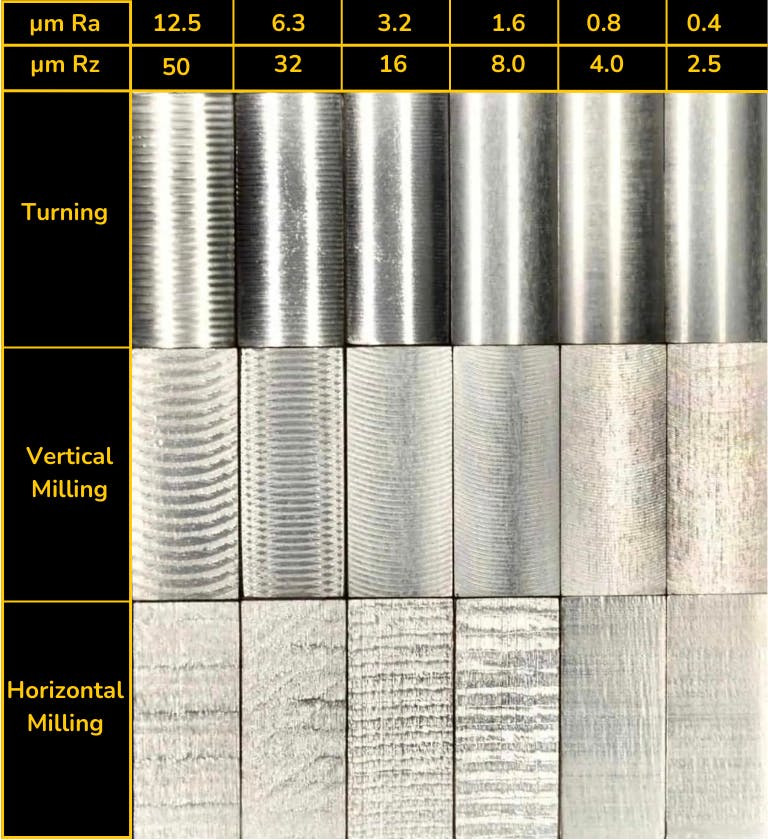
Surface roughness is not random. Instead, manufacturers take deliberate action to achieve specific Ra values. Customers can request a specific surface roughness level for their part. For CNC machining, commonly specified Ra values include:
- 3.2 µm Ra
- 1.6 µm Ra
- 0.8 µm Ra
- 0.4 µm Ra
These surface roughnesses have different textures, characteristics, benefits, limitations, and applications where they are best suited.

3.2 µm Ra CNC machining surface roughness (CNC milling - Aluminium)

1.6 µm Ra CNC machining surface roughness (CNC milling + turning - Stainless steel)

0.8 µm Ra CNC machining surface roughness (CNC turning - Aluminium)

0.4 µm Ra CNC machining surface roughness (CNC turning + polishing - Steel)
Surface Roughness Parameters: Ra vs Rz
Surface roughness is defined using standardised parameters that mathematically describe the surface profile. Choosing the correct roughness parameter is especially important when defining tolerance requirements for functional or mating surfaces. The most common parameters used in CNC machining are Ra and Rz, but others are also relevant in precision applications.
Ra - Roughness Average
Ra (Roughness Average) is the most widely used surface roughness parameter in engineering.
It represents the arithmetic average of the absolute deviations of the surface profile from the mean line over a defined sampling length.
Why Ra is used so often:
- Simple to measure and interpret
- Widely accepted in international standards
- Easy to compare across parts and suppliers
Limitations of Ra:
Ra provides an average value and does not show extreme peaks or deep valleys. Two surfaces with very different textures can have the same Ra value. For example, a Ra 3.2 surface finish might be used for a general-purpose CNC part, while a Ra 1.6 surface finish is often used for precision CNC parts.
Rz - Mean Roughness Depth
Rz measures the average height difference between the highest peaks and lowest valleys within multiple sampling lengths.
Why Rz matters:
- Highlights surface extremes that Ra may hide
- Useful for parts where peak height or valley depth affects performance (e.g. sealing surfaces)
Because Rz captures maximum deviations, it is often higher than Ra and more sensitive to surface damage or tool wear.
Other Surface Roughness Parameters
In some applications, additional parameters are specified:
- Rq (Root Mean Square Roughness) - Similar to Ra but more sensitive to large deviations
- Rt (Total Roughness Height) - Maximum peak-to-valley height over the entire evaluation length
- Rsk (Skewness) - Indicates whether the surface has more peaks or more valleys
These parameters are typically used in high-precision, tribology or quality-critical applications.
Typical CNC Machining Surface Roughness Values
The achievable surface roughness depends on the machining process, tooling, material and post-processing steps. These values are often used alongside available surface finish options when selecting the most suitable manufacturing approach.
Below are typical Ra values used as reference in CNC machining:
| Surface roughness (Ra) | Typical machining condition | Common applications |
|---|---|---|
| 6.3–12.5 µm Ra | Rough machining, high feed rates, minimal finishing | Non-functional surfaces, internal features, structural parts where surface quality is not critical |
| 3.2 µm Ra | Standard CNC machining finish | General-purpose machined parts, housings, brackets, and non-sliding functional surfaces |
| 1.6 µm Ra | Controlled finishing passes, optimised cutting parameters | Functional surfaces requiring moderate precision, mating surfaces, light sliding contact |
| 0.8 µm Ra | Fine finishing passes, sharp tooling, reduced feed rates | Precision components, bearing fits, shafts, and close-tolerance assemblies |
| 0.4 µm Ra and below | Specialised finishing, polishing, grinding, or honing | High-precision components, sealing surfaces, hydraulic systems, and critical wear interfaces |
How to Choose the Right CNC Surface Roughness
While surface roughness is inconsequential in certain applications, it plays a vital role in several others. In critical applications, surface roughness can impact parts' functionality, performance, durability, and aesthetics. It also impacts machining time and cost. CNC machining surface roughness level requirements vary by application. There are no inherently good or bad levels, only appropriate levels for the specific requirement. Therefore, specifying the right CNC machining surface roughness for your part is crucial. The following are important considerations in the selection process.
Start with the function of the surface rather than choosing the lowest Ra value available. A non-contact housing surface does not normally need the same roughness requirement as a bearing seat, sliding interface or sealing face.
Before specifying a tighter surface roughness, consider how the surface interacts with other components, whether it needs to seal or retain lubrication, whether it will receive a coating or secondary finish, and whether the tighter requirement provides a functional benefit.
How Surface Roughness Affects CNC Part Performance
Surface roughness is more than just a visual characteristic in CNC machining. It directly affects how a part performs, wears, seals, and interacts with other components in real-world applications. Rougher surfaces can increase friction and wear in moving parts, while smoother finishes are often required for precision components and sealing surfaces. Proper surface roughness also helps retain lubrication, improves coating adhesion, and enhances the overall appearance and perceived quality of machined parts.
How Is Surface Roughness Measured?
Surface roughness is normally verified using an instrument that records or scans the surface profile and calculates parameters such as Ra or Rz. The appropriate measurement method depends on the required accuracy, the material and whether physical contact with the surface is acceptable.
| Measurement method | How it works | Key advantages | Limitations | Typical use cases |
|---|---|---|---|---|
| Contact profilometers | A stylus traces the surface and records vertical height variations | High accuracy, widely standardised, common in manufacturing inspection | May damage soft or delicate surfaces, slower speed | CNC machining inspection, quality control, shop-floor measurements |
| Non-contact & optical methods | Lasers or optical sensors scan the surface without contact | No surface damage, fast acquisition, ideal for smooth surfaces | Higher equipment cost, sensitive to surface reflectivity | Precision components, delicate materials, high-resolution analysis |
How to Choose the Right Measurement Method
- Use contact profilometers for routine inspection and standard Ra/Rz verification
- Use non-contact methods for delicate parts, very low roughness values, or when surface damage must be avoided
Surface Finish Symbols and Drawing Callouts
Surface roughness requirements should be communicated clearly on the engineering drawing so that the designer, manufacturer and inspection team are working to the same specification.
ISO 21920-1:2021 defines how profile surface-texture requirements are indicated in technical product documentation using graphical symbols, while ISO 21920-2:2021 covers the terms, definitions and parameters used to describe profile surface texture.
A surface-texture callout may include the roughness parameter and limit, along with additional information where the manufacturing process, measurement conditions or direction of surface lay are important. For critical surfaces, the specification should reflect the actual functional requirement rather than simply applying the lowest Ra value across the component.
How to Achieve the Desired Surface Roughness
Achieving a specific surface roughness requires control over multiple machining variables. Surface quality is not determined by a single factor but by the combined effect of cutting parameters, tooling condition, material behaviour and machine stability. Understanding how these elements interact allows manufacturers to reach the required roughness consistently without excessive trial-and-error or unnecessary cost.
Machining Parameters
Machining parameters play a direct role in how smooth or rough a machined surface becomes. Small adjustments to feed rate, cutting speed and depth of cut can significantly influence surface texture, especially during finishing operations. The impact of feed rate and cutting speed varies depending on whether the part is produced using milling or CNC turning processes.
- Lower feed rates generally produce smoother surfaces
- Optimised cutting speed reduces vibration and chatter
- Smaller depth of cut improves finish during finishing passes
Tooling and Tool Condition
Tool selection and condition are critical for achieving consistent surface roughness. Even with optimised machining parameters, worn or improperly designed tools can introduce surface defects and irregularities.
- Sharp tools reduce tearing and surface defects
- Proper tool geometry minimises vibration
- Worn tools significantly worsen surface roughness
Material Selection
Some materials naturally machine to smoother finishes than others. Softer or ductile materials may require adjusted parameters to avoid smearing.
Post-Processing
Grinding, polishing, honing or blasting can be used to achieve surface roughness levels beyond what machining alone can provide.
Surface Roughness Selection Guide by Application
Choosing the correct surface roughness should always balance function, cost and manufacturability. Depending on the application, Ra 3.2 might be sufficient, while more precision parts may need Ra 1.6 or better.
| Application type | Functional requirement | Typical recommended Ra range |
|---|---|---|
| Structural parts | Strength and dimensional accuracy are more important than surface texture | 3.2–12.5 µm Ra |
| Sliding or rotating components | Reduced friction and wear between moving surfaces | 0.8–1.6 µm Ra |
| Cosmetic or visible parts | Visual appearance and perceived quality | 0.8–3.2 µm Ra |
| Sealing interfaces | Leak prevention and consistent surface contact | 0.4–0.8 µm Ra |
Surface Finish Conversion Chart
Surface roughness is often measured using Ra values. However, other measurement systems exist, such as RMS values, roughness grade numbers, and their imperial unit. The image below is a surface finish conversion chart.
| Roughness grade numbers | American system | Metric system | ||
|---|---|---|---|---|
| Ra (µin) | RMS (µin) | Ra (µm) | RMS (µm) | |
| N12 | 2000 | 2200 | 50 | 55 |
| N11 | 1000 | 1100 | 25 | 27.5 |
| N10 | 500 | 550 | 12.5 | 13.75 |
| N9 | 250 | 275 | 8.3 | 9.13 |
| N8 | 125 | 137.5 | 3.2 | 3.52 |
| N7 | 63 | 69.3 | 1.6 | 1.76 |
| N6 | 32 | 35.2 | 0.8 | 0.88 |
| N5 | 16 | 17.6 | 0.4 | 0.44 |
| N4 | 8 | 8.8 | 0.2 | 0.22 |
| N3 | 4 | 4.4 | 0.1 | 0.11 |
| N2 | 2 | 2.2 | 0.05 | 0.055 |
| N1 | 1 | 1.1 | 0.025 | 0.035 |
Achievable Surface Roughness (Ra) by Manufacturing Process
Different manufacturing processes produce different levels of surface roughness (Ra). CNC machining methods such as milling, turning, grinding, EDM, and lapping each have their own achievable Ra ranges depending on tool quality, material, and process control. Understanding these ranges helps in selecting the right process for both functional and cost requirements.
These ranges are general references rather than guaranteed limits. Actual surface roughness depends on the material, geometry, tooling, machine condition and process parameters.
| Manufacturing process | Typical Ra range | Surface finish quality | Notes |
|---|---|---|---|
| CNC milling | 1.6–6.3 µm | Medium | Standard machining finish; depends on tool condition and feed rate. |
| CNC turning | 0.8–6.3 µm | Medium to fine | Can achieve smoother finish than milling with optimised parameters. |
| Grinding | 0.2–1.6 µm | Fine | Used for high precision and tight tolerance surfaces. |
| EDM (electrical discharge machining) | 0.3–3.2 µm | Fine | Surface depends on discharge energy and finishing passes. |
| Lapping | 0.01–0.2 µm | Very fine | Ultra-precise finishing process for optical and sealing applications. |
Common Surface Roughness Mistakes
Despite being a standard specification in CNC machining, surface roughness is often misapplied or misunderstood. These common mistakes can lead to unnecessary manufacturing costs, rejected parts or performance issues in the final assembly. Over-specifying surface roughness is a common issue that significantly increases cost and is often linked to design mistakes rather than functional needs.
- Over-specifying surface roughness, increasing cost without functional benefit
- Confusing surface roughness with surface finish (coatings, colour, texture)
- Using Ra alone when Rz or other parameters would be more appropriate
- Ignoring how roughness affects downstream processes like coating or assembly
Best Practices for CNC Machining Surface Roughness
Applying surface roughness requirements correctly helps make sure parts perform as intended while keeping machining costs under control. Following proven best practices allows engineers and manufacturers to specify realistic roughness values that balance functionality, manufacturability and cost. Selecting unnecessarily low roughness values can dramatically increase production time and should be evaluated alongside strategies to reduce machining costs.
- Specify surface roughness only where it matters functionally
- Use Ra for general applications and Rz for critical surfaces
- Communicate surface requirements clearly on drawings
- Consider cost impact before specifying ultra-low roughness
- Align roughness requirements with real operating conditions
Key Takeaways: Specifying Surface Roughness the Right Way
Surface roughness is a fundamental aspect of CNC machining that directly impacts part performance, durability and cost. Understanding the difference between roughness parameters like Ra and Rz, how roughness is measured and how machining choices influence surface texture allows engineers and manufacturers to make smarter, more efficient decisions.
By specifying the right surface roughness, not just the smoothest possible, you achieve optimal performance without unnecessary manufacturing complexity.
CNC Surface Roughness with Geomiq
Geomiq provides CNC milling and turning for prototype and production parts across a wide range of engineering materials.
The standard as-machined surface roughness is 3.2 µm Ra. Where a component requires a finer functional surface, roughness can be specified down to 0.2 µm Ra, depending on the material, geometry and manufacturing requirements.
Our instant quoting platform allows you to select the required specifications and provides manufacturing quotes based on your requirements. Simply upload your design to get started.
What is the standard surface roughness for CNC machining?
What does a 3.2 machined surface finish mean?
What does Ra 0.8 mean in machining?
What is the difference between Ra and Rz?
How is surface roughness measured?
How does surface roughness affect machined parts?
Is surface roughness (Ra) defined according to any international standard?
What is CLA in surface roughness measurement?
What does N7 mean in surface finish grades?
How does surface roughness affect machining cost?
What Ra values can be achieved by different machining processes?
About the author
Sam Al-Mukhtar
Mechanical Engineer, Founder and CEO of Geomiq
Mechanical Engineer, Founder and CEO of Geomiq, an online manufacturing platform for CNC Machining, 3D Printing, Injection Moulding and Sheet Metal fabrication. Our mission is to automate custom manufacturing, to deliver industry-leading service levels that enable engineers to innovate faster.