CNC Chemical Surface Finishes: Types, Benefits & Applications
A CNC-machined component can meet its dimensional requirements and still be unsuitable for its operating environment. An untreated metal surface may corrode, retain machining contamination, wear prematurely or fail to provide the required electrical, cosmetic or bonding properties.
Chemical and electrochemical surface finishes modify the outer layer of a machined component after production. Depending on the process, they can improve corrosion resistance, hardness, wear behaviour, conductivity, insulation, cleanability, paint adhesion or appearance.
Some treatments convert the existing surface, others deposit a new metallic layer, and some remove a controlled amount of material. These differences affect material compatibility, coating thickness, dimensional tolerances and in-service performance.
This guide compares the principal chemical and electrochemical finishes used for CNC-machined parts, explains their engineering benefits and shows how to specify the correct treatment.
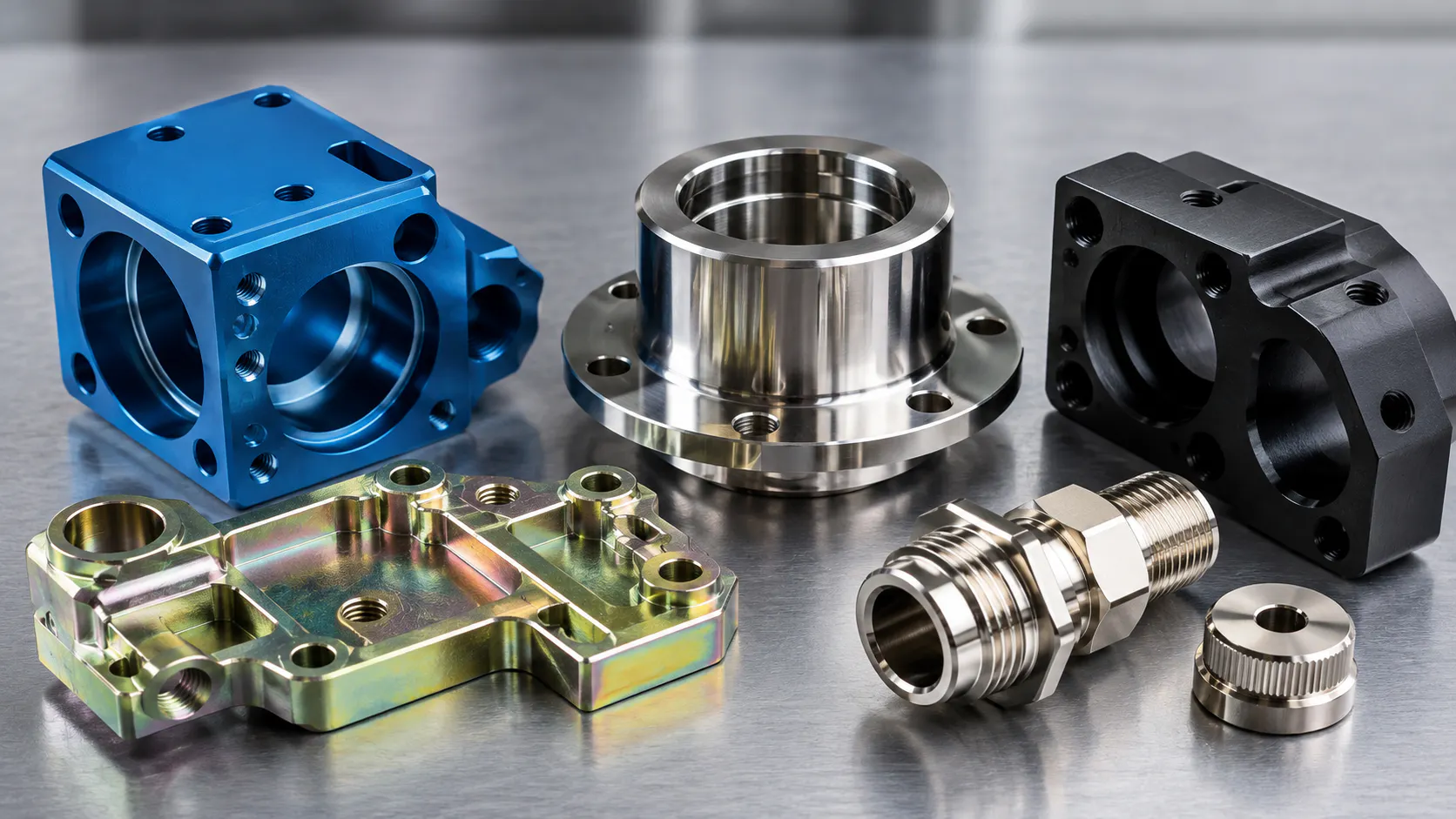
What Are CNC Chemical Surface Finishes?
CNC chemical surface finishes are post-machining treatments that alter the composition or condition of a metal surface through a controlled chemical reaction.
Depending on the process, a treatment may:
- remove machining contamination;
- convert the substrate into a protective compound;
- deposit another metal onto the component;
- increase the thickness of a natural oxide layer;
- remove microscopic surface peaks;
- prepare the surface for paint, adhesives or sealing.
Chemical finishing differs from mechanical finishing. Bead blasting, grinding and mechanical polishing primarily modify a surface through abrasion. Chemical and electrochemical treatments modify it through conversion, deposition or controlled dissolution.
Surface finish should also not be confused with surface roughness. Surface roughness describes microscopic texture using values such as Ra and Rz, while a chemical finish describes a post-machining treatment. Geomiq’s CNC machining surface roughness guide explains this distinction in more detail.
For engineering purposes, the principal treatment groups are:
- Cleaning and passivation: remove contaminants and support an existing passive layer.
- Conversion coatings: chemically transform the outer layer of the substrate.
- Deposited coatings: add another metal through chemical or electrochemical deposition.
- Material-removal processes: dissolve a controlled amount of the original surface.
The selected process determines whether the component’s dimensions remain nearly unchanged, increase through coating build-up or decrease through material removal.
Which Finish Is Suitable for Each CNC Material?
Material compatibility alone does not confirm process suitability. Alloy composition, hardness, heat treatment, welded areas, geometry and trapped chemistry in blind features can also affect feasibility.
| Base material | Commonly suitable finishes | Main selection considerations |
|---|---|---|
| Aluminium | Chromate conversion, anodising, electroless nickel and selected electroplating | Conductivity, wear, colour and tolerance sensitivity |
| Stainless steel | Passivation, electropolishing, electroless nickel and selected electroplating | Cleanliness, corrosion resistance and dimensional control |
| Carbon and alloy steel | Black oxide, zinc plating, nickel plating, electroless nickel and phosphate conversion | Corrosion environment, wear and need for supplementary sealing |
| Copper and brass | Electroless nickel, nickel, tin, silver or gold plating | Conductivity, solderability and tarnish resistance |
| Titanium | Selected anodising and passivation treatments | Oxide control and aerospace or medical requirements |
The exact alloy should be confirmed before specifying the finish. Two alloys from the same material family may respond differently to the same chemical treatmen
What Is the Difference Between Chemical and Electrochemical Surface Finishing?
Chemical finishing relies on a controlled reaction between the component and a treatment solution. Electrochemical finishing also uses a chemical solution, but an applied electrical current drives or controls the surface reaction.
The two categories are commonly discussed together because both are applied after machining and can provide similar engineering functions. However, the process mechanism affects coating thickness, uniformity, conductivity and dimensional change.
| Process category | How the process works | Common examples | Typical dimensional effect |
|---|---|---|---|
| Chemical finishing | The substrate reacts directly with a treatment solution without an externally applied electrical current. | Passivation, chromate conversion, black oxide and electroless nickel | Negligible change, conversion of the surface or controlled coating build-up |
| Electrochemical finishing | Electrical current drives oxidation, deposition or controlled material removal in an electrolyte. | Anodising, electroplating and electropolishing | Oxide growth, metallic coating build-up or controlled material removal |
In this guide, “chemical surface finishes” is used as a practical umbrella term covering both chemical and electrochemical treatments. Where the distinction affects component performance or tolerances, it is explained within the relevant process section.
What Are the Main Benefits of Chemical Surface Finishes?
Chemical and electrochemical finishing can change the functional performance of a CNC-machined component without modifying its core geometry or base material.
The required benefit should be defined before selecting the finish.
| Engineering benefit | How the finish helps | Common treatment options |
|---|---|---|
| Corrosion resistance | Creates a protective surface or removes contaminants that can initiate local corrosion. | Passivation, anodising, chromate conversion and electroless nickel |
| Wear resistance | Produces a harder or more durable outer layer. | Hard anodising and selected electroless nickel systems |
| Minimal dimensional change | Provides surface protection without adding a thick deposited coating. | Passivation, chromate conversion and black oxide |
| Uniform coating coverage | Coats recesses, edges and complex geometry more consistently. | Electroless nickel plating |
| Electrical conductivity | Maintains or adds a conductive surface for grounding, shielding or electrical contact. | Chromate conversion, tin, silver and gold plating |
| Electrical insulation | Produces a non-conductive oxide layer. | Anodising |
| Improved cleanability | Removes contaminants and reduces microscopic surface irregularities. | Passivation and electropolishing |
| Paint or adhesive preparation | Produces a surface that supports coating or adhesive bonding. | Chromate and phosphate conversion coatings |
| Controlled appearance | Creates a defined colour, brightness or decorative surface. | Black oxide, anodising, chemical brightening and electroplating |
The finish must still be assessed against the base material, tolerance requirements and service environment. A treatment selected primarily for appearance may not provide sufficient corrosion, wear or chemical resistance.
Which CNC Chemical Surface Finishes Are Most Common?
Chemical Conversion Coating
A chemical conversion coating forms when the substrate reacts with a treatment solution and becomes a thin protective compound. The base metal participates in the reaction rather than receiving a separate, thick coating.
Conversion coatings are commonly selected to:
- improve corrosion resistance;
- support paint or adhesive bonding;
- preserve close dimensional tolerances;
- modify electrical surface properties.
Examples include chromate conversion on aluminium, phosphate conversion on steel and black oxide on ferrous metals.
The primary engineering advantage is minimal coating build-up. However, conversion coatings generally provide lower abrasion resistance than hard anodising or wear-resistant metallic plating.
Chromate Conversion Coating
Chromate conversion coating, commonly called chem film, is widely applied to CNC-machined aluminium. It produces a thin reaction layer that improves corrosion resistance and paint adhesion while causing minimal dimensional change.
Selected chromate conversion coatings remain electrically conductive. This makes them suitable for housings, panels and structural components requiring grounding, bonding or electromagnetic interference shielding.
MIL-DTL-5541 is commonly specified for aluminium conversion coatings:
- Class 1A: prioritises corrosion protection and paint adhesion.
- Class 3: is used where low electrical contact resistance is required.
The technical drawing should also state whether hexavalent or trivalent chromium chemistry is permitted.
See Geomiq’s guide to CNC chromate conversion coating for further detail.
Passivation of Stainless Steel
Passivation is primarily used for stainless-steel components. CNC machining can leave cutting-fluid residue, embedded free iron and tool contamination on the surface, reducing local corrosion resistance.
The part is cleaned and treated in a controlled nitric- or citric-acid solution. The treatment removes free iron and supports formation of the chromium-rich passive oxide layer.
ASTM A967/A967M is commonly used to specify chemical passivation treatments for stainless-steel parts.
Key characteristics of passivation include:
- no conventional coating build-up;
- negligible dimensional change;
- removal of free iron and surface contamination;
- improved corrosion performance of a correctly selected stainless-steel alloy.
Passivation is widely used for medical, laboratory, pharmaceutical, food-processing, aerospace and fluid-handling components.
It does not remove deep tool marks or correct poor machining. Where improved micro-smoothness is also required, electropolishing may be more appropriate.
See Geomiq’s stainless steel CNC machining guide for material-specific guidance.
Electroless Nickel Plating
Electroless nickel plating deposits a nickel-phosphorus alloy through an autocatalytic chemical reaction. Unlike conventional electroplating, it does not rely on an externally applied electrical current.
This allows the coating to cover recesses, edges and complex geometry more uniformly than many electrolytic plating processes.
Electroless nickel is commonly selected for:
- corrosion resistance;
- wear protection;
- controlled surface hardness;
- uniform coating thickness;
- protection of complex internal and external geometry.
It can be applied to aluminium, carbon steel, stainless steel and copper alloys with suitable surface preparation. ASTM B733 is a commonly used specification for autocatalytic nickel-phosphorus coatings.
Phosphorus content affects performance:
- Lower-phosphorus coatings generally favour hardness and wear resistance.
- Higher-phosphorus coatings are commonly selected for corrosion resistance.
Electroless nickel adds measurable material. Bores become smaller, shafts become larger and threads may tighten. The specified coating thickness must therefore be included in the machining and tolerance strategy.
Black Oxide
Black oxide is a chemical conversion treatment used mainly on ferrous metals. It forms a dark oxide layer with minimal dimensional build-up.
Typical applications include:
- fasteners;
- tools;
- fixtures;
- gears;
- machine components;
- optical or mechanical parts requiring reduced glare.
Black oxide is suitable where controlled appearance and dimensional stability are important.
However, the oxide layer alone provides limited barrier protection. Oil, wax or another supplementary sealant is normally required where corrosion resistance is expected.
Black oxide should not be treated as a substitute for a high-performance protective coating in marine, outdoor or chemically aggressive environments.
Chemical Brightening
Chemical brightening removes a controlled amount of material from an aluminium surface to produce a smoother and more reflective appearance.
It is often used before decorative anodising for:
- housings
- panels
- trim components
- display parts
- consumer-product components
The process is primarily cosmetic. It does not provide the corrosion or wear protection associated with anodising or metallic plating.
Final appearance depends on the aluminium alloy and the initial machined surface. Deep scratches, porosity and pronounced machining marks may remain visible after treatment.
Electropolishing
Electropolishing is an electrochemical material-removal process used mainly on stainless steel. During treatment, microscopic surface peaks dissolve faster than lower areas, producing a brighter and more uniform surface.
Electropolishing can:
- improve cleanability;
- remove small accessible burrs;
- reduce surface contamination;
- improve micro-smoothness;
- support corrosion resistance.
Typical applications include medical, pharmaceutical, food-processing and fluid-handling components.
Electropolishing removes material rather than adding a coating. The material-removal allowance must therefore be considered on:
- precision bores;
- sealing surfaces;
- thin walls;
- sharp edges;
- critical datum features.
The process improves micro-smoothness but does not correct deep scratches, geometric errors or poor machining quality.
Anodising
Anodising is an electrochemical conversion process used principally for aluminium. It increases the thickness of the naturally occurring oxide layer and creates a finish that is integrated with the substrate.
The two commonly specified categories are:
- Type II sulphuric anodising: used for decorative finishes and general corrosion protection.
- Type III hard anodising: produces a thicker and harder oxide layer for wear-resistant applications.
Anodising can improve:
- corrosion resistance;
- surface hardness;
- wear resistance;
- electrical insulation;
- cosmetic appearance.
Because the oxide grows partly into and partly above the original surface, anodising affects component dimensions.
Threads, precision bores, bearing fits, sealing surfaces and electrical contact areas may require machining allowances or masking.
Geomiq’s guide to the aluminium anodising process and benefits explains the process in more detail.
Electroplating
Electroplating uses electrical current to deposit a metallic coating onto a conductive component.
Common deposited metals include:
- zinc
- nickel
- Tin
- copper
- chromium
- silver
- gold
The deposited material determines the function of the coating:
- Zinc: corrosion protection for steel.
- Tin: solderability and electrical contact performance.
- Nickel: wear resistance, corrosion resistance and appearance.
- Chromium: hardness, wear resistance and decorative appearance.
- Silver and gold: electrical conductivity and contact reliability.
Coating thickness varies with current density and component geometry. Exposed edges may receive more material than recesses, while rack position and electrical contact points can affect coating uniformity.
Critical features may therefore require masking, machining allowances or post-plating inspection.
How Do the Main CNC Chemical Finishes Compare?
The following comparison provides initial engineering guidance. Final performance depends on the alloy grade, surface preparation, coating class, sealing method, thickness and testing requirements.
| Finish | Process type | Common substrates | Main engineering benefit | Dimensional effect |
|---|---|---|---|---|
| Passivation | Chemical cleaning and conditioning | Stainless steel | Removes free iron and supports corrosion resistance | Negligible |
| Chromate conversion | Chemical conversion | Aluminium and selected non-ferrous alloys | Corrosion protection, paint adhesion and conductivity | Minimal |
| Electroless nickel | Autocatalytic deposition | Aluminium, steel, stainless steel and copper alloys | Uniform corrosion- and wear-resistant coating | Measurable build-up |
| Black oxide | Chemical conversion | Ferrous metals | Controlled black appearance with limited dimensional change | Minimal |
| Chemical brightening | Chemical material removal | Mainly aluminium | Brighter decorative surface | Low material removal |
| Electropolishing | Electrochemical material removal | Mainly stainless steel | Cleanability and micro-smoothing | Controlled material removal |
| Anodising | Electrochemical conversion | Mainly aluminium | Hardness, wear resistance, corrosion protection and insulation | Measurable oxide growth |
| Electroplating | Electrochemical deposition | Conductive metals and prepared substrates | Conductivity, solderability, wear resistance or corrosion protection | Variable build-up |
The exact alloy should be confirmed before specifying the finish. Two alloys from the same material family may respond differently to the same chemical treatment.
How Do Chemical Finishes Affect Dimensions and Tolerances?
Surface finishing should be included in the tolerance strategy before production begins.
Different treatments affect dimensions in different ways:
- Negligible dimensional change: passivation and thin conversion coatings.
- Material build-up: electroless nickel, anodising and electroplating.
- Material removal: electropolishing and chemical brightening.
These changes can affect:
- hole and bore diameters;
- shafts and bearing fits;
- internal and external threads;
- sealing surfaces;
- datum features;
- thin walls and sharp edges;
- electrical contact areas.
A deposited coating reduces the diameter of a bore and increases the diameter of a shaft.
On threaded features, the coating affects opposing flanks. The total influence on thread fit may therefore exceed the coating thickness measured on one external surface.
What Should Be Included in the Drawing Callout?
A complete finishing callout should identify:
- the finishing process;
- the governing standard;
- the required type, class or chemistry;
- coating thickness or material-removal allowance;
- surfaces that must be treated;
- features that must be masked;
- whether dimensions apply before or after finishing;
- inspection and testing requirements;
- certification or traceability requirements.
Instructions such as “nickel plate” or “anodise black” are not sufficiently precise where multiple process types, coating classes and thickness ranges are available.
How Should Engineers Select a CNC Chemical Surface Finish?
The selection process should start with the required engineering function rather than a preferred coating name.
1. Define the Required Performance
Determine whether the component requires:
- corrosion protection;
- wear resistance;
- electrical conductivity;
- electrical insulation;
- improved cleanability;
- paint or adhesive adhesion;
- controlled appearance.
2. Confirm the Base Material
The finish must be compatible with the exact alloy and heat-treatment condition.
Aluminium, stainless steel, carbon steel, copper alloys and titanium require different surface preparation and process control.
3. Review Dimensional Sensitivity
Determine whether the treatment adds material, removes material or causes negligible dimensional change.
Precision bores, threads, bearing fits, sealing faces and mating surfaces may require machining allowances or masking.
4. Assess the Operating Environment
Review expected exposure to:
- moisture;
- chemicals;
- temperature;
- abrasion;
- cleaning agents;
- electrical contact;
- outdoor or marine conditions.
A decorative treatment may not provide sufficient protection for a chemically aggressive or high-wear environment.
5. Review Component Geometry
Wet chemical treatments require effective drainage.
Blind holes, deep recesses and enclosed cavities may trap processing chemistry. Racking points and electrical contact locations may also leave small marks on the component.
6. Confirm the Applicable Standard
The drawing should identify the required process standard, type, class, thickness, masking and inspection requirements.
Geomiq’s CNC design guide provides additional design-for-manufacture guidance.
Where Are CNC Chemical Surface Finishes Used?
Aerospace Components
Aerospace components may use chromate conversion, anodising, electroless nickel or passivation to balance:
- corrosion resistance
- electrical conductivity
- wear resistance
- dimensional control
- traceability and inspection requirements
Medical and Pharmaceutical Components
Stainless-steel medical and pharmaceutical parts commonly use passivation or electropolishing where corrosion resistance, contamination control and cleanability are important.
The treatment does not replace hygienic component design, suitable material selection or validated cleaning procedures.
Electronics and Electrical Components
Electronics applications use conversion coatings and metallic plating for:
- grounding
- electromagnetic interference shielding
- electrical contacts
- solderability
- connector performance
Automotive and Industrial Components
Automotive and industrial components may use zinc plating, black oxide, anodising or electroless nickel for:
- fasteners
- shafts
- fixtures
- housings
- gears
- wear-sensitive components
Decorative and Consumer Components
Decorative anodising, chemical brightening and electroplating are used where appearance must be combined with corrosion protection or surface durability.
Geomiq’s broader CNC surface finishes page presents available options for machined components.
How Should CNC Parts With Chemical Finishes Be Ordered?
Finish requirements should be submitted with the CAD model and technical drawing. They should not be added after machining has already started.
Include the following information in the quotation package:
- material and alloy grade;
- required finishing process;
- governing specification or standard;
- process type or class;
- required coating thickness;
- surfaces requiring treatment;
- masked features;
- critical dimensions after finishing;
- cosmetic or colour requirements;
- inspection and certification requirements;
- required quantity;
- delivery date.
Defining the finish at the quotation stage allows machining allowances, racking, masking, inspection and lead time to be planned as one production workflow.
Need Help Choosing the Right Chemical Surface Finish?
Need help choosing the right chemical surface finish for a CNC-machined part? Upload your CAD file through Geomiq’s online CNC machining services platform to specify finishing and inspection requirements and get a quote for prototype or production parts.
Geomiq’s platform brings CNC machining, surface finishing, quality control and order management into one workflow, helping engineering and procurement teams source finished components with clearer specifications and fewer production assumptions.
FAQs
What Is Chemical Conversion Coating?
Is Chromate Conversion Coating the Same as Anodising?
Is Chromate Conversion Coating the Same as Chem Film?
What Is the Difference Between Nickel Plating and Electroless Nickel Plating?
What Is Passivation of Stainless Steel?
About the author
Sam Al-Mukhtar
Mechanical Engineer, Founder and CEO of Geomiq
Mechanical Engineer, Founder and CEO of Geomiq, an online manufacturing platform for CNC Machining, 3D Printing, Injection Moulding and Sheet Metal fabrication. Our mission is to automate custom manufacturing, to deliver industry-leading service levels that enable engineers to innovate faster.